Birding Wire

Editors Afield

Peter found an array of birds on the Carolina coast this week: My wife and I snuck in a quick trip to the South Carolina coast this past weekend. When I awoke to cool temps and a brisk west wind, I thought things might be hopping at Huntington Beach State Park. As I rode my bike into the park, I noted many Gray Catbirds flitting across the path and heard flocks of migrating Blue Jays raucously calling. A couple hundred Tree Swallows hung overhead, suspended motionless in the stiff winds. Five Bald Eagles were in view simultaneously.
Read Full Release →

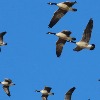
The change in weather last week was the catalyst to separate early fall from late fall. Arctic-nesting waterfowl migrated into the area, marking one of my favorite times of the year. Seven Tundra Swans were present a couple days a mile north of home, and about 40 Tundras were loafing 10 miles south. A couple hundred Snow Geese were flocked at Hille Lake to the south with and a dozen White-fronts and a few Cackling Geese mixed among about 100 Canada Geese.

Read Full Release →

I celebrated National Wildlife Refuge Week with hundreds of Gray Catbirds and other migrants at the Savannah National Wildlife Refuge in South Carolina. Best birds of the day for me were a Yellow-breasted Chat and a nice Merlin feeding on a dragonfly. White-eyed Vireos were abundant; there seemed to be one or two in every brush patch. There was a nice movement of Indigo Buntings in particular – I tallied 11 Indigos, along with one nice bright-green juvenile male Painted Bunting.


Read Full Release →

Lightening does strike twice, at least with regard to new yard birds! Just a couple weeks ago I shared that the immature male Baltimore Oriole that appeared at my hummingbird feeder was yard bird #124, according to the list that I’ve accumulated on eBird. If I can add one new species a year to my yard list here in South Carolina, I’m thrilled. So, that made this week’s yard bird #125 even more exciting!

Read Full Release →

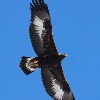
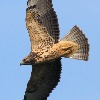
I noticed a big dark bird flying my way, bucking the strong west wind. As it approached, soaring into better sunlight, I realized it was a beautiful young Golden Eagle with fresh new plumage accented by extensive white “patches” on its wings and the base of its tail feathers. I was impressed, surprised and excited. Very few Golden Eagles appear in this area, usually during winter, so this Golden was particularly early and unexpected.

Read Full Release →

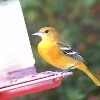
A flash of orange at one of our hummingbird feeders caught my eye this week. It was an immature male Baltimore Oriole. It started feeding on a sugar water feeder just six feet from our kitchen window, then moved to another pair of feeders in the yard. I raced to the pantry and dusted off an oriole feeder that I bought several years ago and retired after two or three seasons without orioles. It has larger feeding ports so orioles can get their beaks to the nectar and small trays for jelly. I loaded it up and put it out. Just a few minutes later the oriole returned and sipped nectar from it.

Read Full Release →

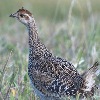
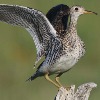
Tuesday I had a chance to photograph a few individuals of what appeared to be a family flock of Sharp-tailed Grouse, but I was surprised to see a young cock pheasant with them. It made me wonder, was this a chance meeting of the two species, or did a hen pheasant lay one or more eggs in a grouse nest? Ring-necked Pheasant hens are known to lay eggs in the nests of other large ground-nesting birds. In fact, a few years ago I found a Mallard nest that had three pheasant eggs among the clutch she was incubating. Wish I could have seen the look on the face of the downy pheasant hatchlings when the Mallard hen led them to water with their Mallard step-ducklings.

Read Full Release →

Our yard and feeders are flush with fledglings! American Goldfinches are bringing their fledglings to the sunflower feeder, and because I’ve never heard their food-begging calls before I was quite surprised. They are soft and plaintive, and they seem to be working because four young birds flew off trailing two adults. A family of Brown-headed Nuthatches announces their arrival with their toy horn-sounding calls. A group of five worked their way through the pines to the feeding station as we watched last night.

Read Full Release →

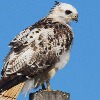
Krider’s Red-tailed Hawks have been moving into the area in earnest this week; I’m seeing an average of two per day. Mid-August is the start of more serious hawk migrations across the high plains and Krider’s Redtails are the most obvious of the rarer raptors that stop here for a day or a couple weeks between now and mid-October. Krider’s are distinguished by a white head and undersides with varying amounts of white plumage coloration on their back and tail; some Krider’s have almost white tails.


Read Full Release →

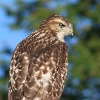
A priority for the past two weeks has been monitoring my two favorite hawk broods daily, including three fledged Red-tails and three fledged Ferruginous Hawks. One Red-tail fledgling took things a big step forward Monday when I saw it grabbing at things on the ground. While standing, it reached out with a talon to grab at something, maybe a big bug, then skip a couple steps to the right and grab at another small moving entity that caught its eye. That’s the kind of behavior I expect when the hawks are learning to hunt; it’s the period when young birds of prey tend to grab at everything that moves as a vital part of learning to hunt.

Read Full Release →

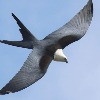
Swallow-tailed kites nest in swamps and riverine forests in good numbers here in the Southeast along the Atlantic Coast from the Carolinas south to the Everglades. About mid-July or so, Swallow-tailed Kites gather in pre-migration communal roosts all the way south through the Florida peninsula. We are blessed to have a couple of kite roosts located just an hour from home and it’s a short migration I love to make. Seeing one or two of these stunning birds is thrilling; seeing dozens at a time is life-changing.


Read Full Release →

A couple memorable sightings stand out: A female Northern Harrier diving at a Golden Eagle as it soared along the edge of a steep Badlands cliff; adult Rock Wrens feeding two fledglings on a wind-carved sandstone outcrop; and an American Kestrel in flight holding unusual prey in its talons – a small snake – with a Western Kingbird diving at the mini-falcon on the wing.

Read Full Release →