
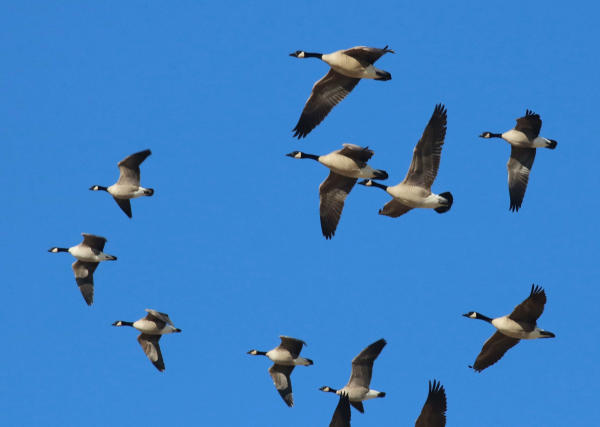
 Many Arctic-nesting birds migrated to Dakota this week, including a flock of Cackling Geese that mixed with larger Canada Geese. 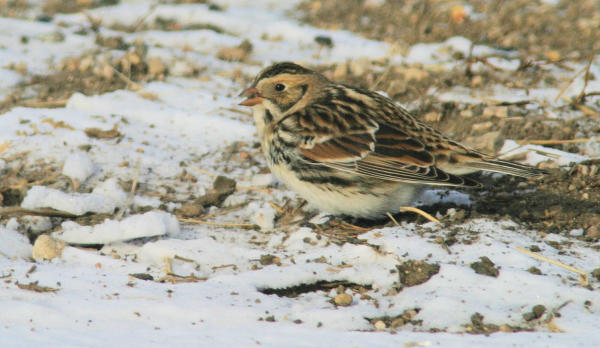 A Lapland Longspur was another recent Arctic-nesting migrant, one among a flock of about 70. Many more will follow. 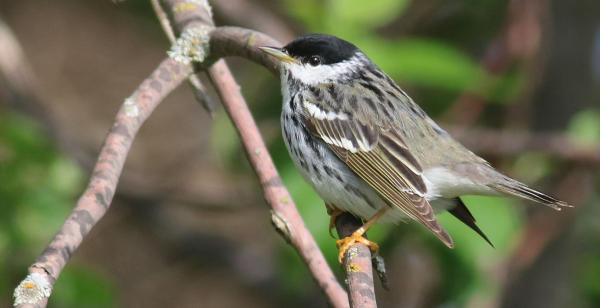 A Blackpoll Warbler provided Peter with a memorable sighting on a day when 13 species of warblers dominated his Georgia ebird list. |
Paul shared last week’s mid-October highlights first: The change in weather last week was the catalyst to separate early fall from late fall. Arctic-nesting waterfowl migrated into the area, marking one of my favorite times of the year. Seven Tundra Swans were present a couple days a mile north of home, and about 40 Tundras were present 10 miles south. A couple hundred Snow Geese were flocked at Hille Lake to the south with and a dozen White-fronts and a few Cackling Geese mixed among about 100 Canada Geese.
Although the blizzard snow melted in two days, the cold continued through last weekend, and ice covered smaller shallow marshes and formed along the shores of some medium-sized wetlands. Over the weekend, most wading birds left, most notably Great Egrets and White-faced Ibis, with a couple Great Blue Herons lingering. Double-crested Cormorants also left along with the last Franklin’s Gulls, collectively marking a definite changing of the guard.
With many Red-tailed Hawks moving through the area, Monday’s highlight was a Prairie Falcon in flight near the mixed flock of geese, which included more Cacklers and Canadas, as well as about 40 White-fronts and more Snows. Those numbers will continue to grow and many more flocks will arrive until after freeze-up, which has taken place during mid-December the past three years, but has happened by mid-November some years a decade ago.
Yard birds have included more Blue Jays, a few quick-moving flocks of Chipping Sparrows and Dark-eyed Juncos, a Hermit Thrush and an occasional Ruby-crowned Kinglet (more kinglets than ever this fall). No changes at my feeding station – Downys, a female Hairy and White-breasted Nuthatches.
Migration was very quiet Tuesday through Thursday, and that was the theme across the eastern third of the state as I drove to Fargo – just widely scattered Red-tailed Hawks to note. Friday showed more promise when I found a big flock of the first Arctic songbird migrants – about 70 Lapland Longspurs that were drinking in a small shallow wetland. It was interesting to see them fly up to the water, land on emergent sedges, drink quickly, then take flight, but circling back and repeating the action time and time again. No Snow Buntings among them, but these beautiful little Arctic-nesting songbirds can’t be far behind. Usually they form mixed flocks with the longspurs and are easily differentiated in flight and on the ground by their more extensive white plumage.
A short time later Friday afternoon, I reveled at the opportunity to observe, hear and photograph a large collection of geese assembling to feed about 11 miles south of home. That story is chronicled in this issue’s Photography article as about 1,500 Snows and a couple hundred White-fronts were joined by a few Ross’s and Cackling Geese mixed in the feeding flocks. While entranced with the action of the feeding melee, I heard the distant familiar calls of a migrating flock of Sandhill Cranes that I eventually located flying south in a long string. Ah yes, the beautiful mix of goose music with ethereal crane calls.
Peter could barely contain his excitement: It was a magical morning among warblers this past week at Phinizy Swamp in Augusta, Georgia. I was no sooner out of my car when I heard two House Wrens singing phrases of their song. They are welcome fall migrants and signaled what I hoped would be a good day.
Phinizy Swamp Nature Park (an eBird hotspot) is about 1,100 acres in size and includes a system of man-made wetland cells that are used to filter treated wastewater. The cells are magnets for birds and birders. On this morning I decided to hike an elevated trail that circles what locals call the Equalization Pond. The trail is bordered by second growth hardwoods, as well as tall pines and hardwoods. It was a very good choice!
For the first time this fall, I had a great day with warblers. I tallied 13 species including 3 Black-and-whites, 2 Tennessees, 5 Common Yellowthroats, 5 American Redstarts, at least 6 Cape Mays, 10 Parulas, 4 Magnolias, 1 Bay-breasted, 1 Blackpoll, 1 Blackburnian, more than 20 Palm Warblers (mostly the “Western” version that isn’t very colorful), 6 Pine Warblers and 5 “Myrtle” Yellow-rumped Warblers.
The bird list doesn’t begin to tell the story though. Because the trail is elevated and the bordering trees only medium-tall, most of my looks were of birds at eye-level or below. The Blackpoll probably afforded the best look at a fall Blackpoll I’ve ever had. It was maybe 20 feet away and viewed with a dark background of vegetation. I could see its green-tinted, streaked back, faint but distinct streaks on its side, and best of all, its yellow feet and lower legs. I always chuckle when I read in identification guides that the yellow feet of this species is a distinguishing marking. Most of the fall Blackpolls I see are 75 feet high in the top of a tree and backlighted. I’m lucky to see the bird, much less the color of its feet.
At one point, I had 5 Cape Mays, 2 Parulas, 1 Tennessee, 1 Magnolia and a Red-winged Blackbird simultaneously in view in a small tree just a few feet away. The birds were feeding on caterpillars and other insects and seemed oblivious to my presence. It was a glorious morning; one of those days when I think about just how blessed I am to be a birder!
Photographs by Paul Konrad
Peter Stangel and Paul Konrad are the editors of The Birding Wire; share your sightings or photos at editorstbw2@gmail.com