
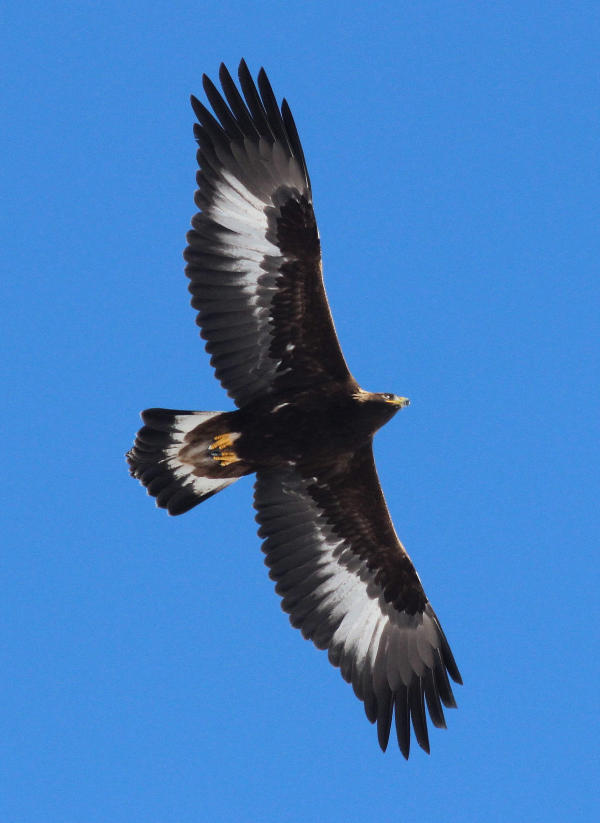
 A spectacular first-year Golden Eagle soaring. 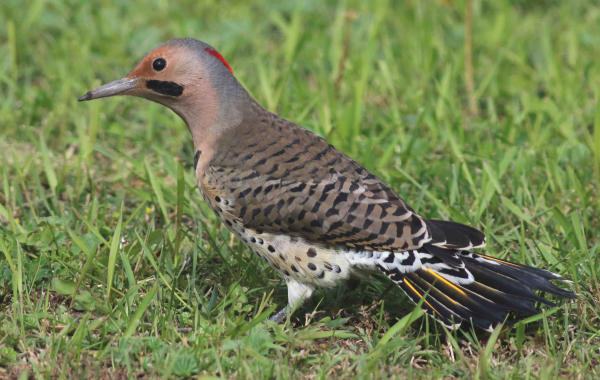 A neighborhood male Yellow-shafted Northern Flicker. 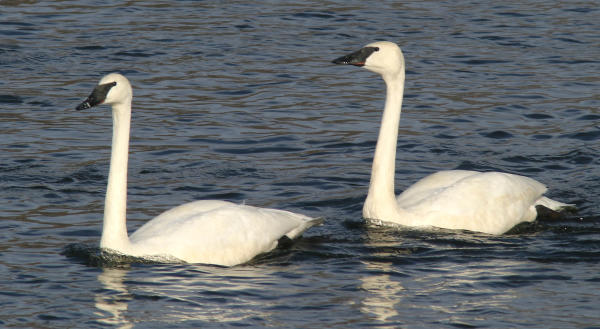 Friday, Paul found a rare pair of Trumpeter Swans. |
Paul began the first week of fall run-down: Sunday wasn’t productive in the field, but when I returned home I found myself parked in an opening on the edge of my property, observing and photographing the action in the mix of trees, shrubs, vines and grass. Many American Robins were feeding on wild grapes that have vined thickly up one tall ash tree and are growing along the ground below the chokecherry bushes. It was quite a colorful setting with the ash trees colored fall yellow and the grape leaves bright red. Adding to the color were a couple Blue Jays collecting food in the undergrowth and a Red-breasted Nuthatch, Yellow-rumped Warblers and Ruby-crowned Kinglets actively gleaning small insects in the trees and bushes with several Northern Flickers feeding on ants on the ground.
Back in the house, I saw the first Hairy Woodpecker come to my hot suet feeder, a female, preceded by the first fall Blue Jay drinking from my birdbath. The jay shunned the blueberries I had just put in the water basin – the wild grapes must have been better.
Monday was a quiet day in the neighborhood, but Tuesday and Wednesday brought impressive waves of migrants. The best mixed species flock to move past my windows included Orange-crowned Warblers, Yellow-rumps, Red-breasted Nuthatches, Hermit Thrushes, Northern Flickers, American Robins, Chipping Sparrows and two first-of-the-decade Eastern Towhees! I actually hosted both Eastern and Spotted Towhees one spring about 15 years ago, but haven’t seen either species for many years, and never during fall.
Then Wednesday, all the above species except the towhees moved through, along with the first fall sightings of Dark-eyed Juncos, White-throated Sparrows and Brown Creepers (a favorite), plus a couple more Ruby-crowned Kinglets. Standing in the bay window addition of my living room, it felt like I was closely surrounded by these birds, at least on three sides.
Later, while pre-occupied checking out some barnwood north of town, I noticed a big dark bird flying my way, bucking the strong west wind. As it approached, soaring into better sunlight, I realized it was a beautiful young Golden Eagle with fresh new plumage accented by extensive white “patches” on its wings and the base of its tail feathers. I was impressed, surprised and excited. Very few Golden Eagles appear in this area, usually during winter, so this Golden was particularly early and unexpected.
Friday, four first-of-fall Buffleheads (two males and two females) caught my eye in the wetland just a half-mile south of home. Farther south, just as I slipped over a hill I was surprised to see two swans; it seemed early for Tundras, and they were a bit larger – Trumpeters I thought. I took a look through binoculars and sure enough, Trumpeters they were – the first I’ve ever seen in North Dakota. Two miles north, I found a mixed flock of songbirds, highlighted by some stunning male Harris’s Sparrows (first of the season) with a White-throated Sparrow, a Song Sparrow and a Slate-colored Junco.
Two miles north of there, I saw a distant mid-sized raptor and hoped it might be a falcon. Closer, I took a quick binocular view and was thrilled to see it was a stunning adult Peregrine, now perched in a lone white, barkless dead tree. When I was getting close enough to try photographing, I realized the falcon’s head was partly behind a big branch. I pressed a little closer and the Peregrine hopped to another position, party behind another big branch. I tried to get into position where the falcon was clear, and hoped if it flew, it would fly my way.
I could see it was edgy, but I was able to take one photo before it flew, and I followed its flight taking a few long-distance images. Although the snag branches didn’t permit a good image, it was close to being a great photo opportunity. I followed the rest of the Peregrine’s flight through binoculars until it landed atop a high prairie hill, surrounded by miles of high prairie hills – this sighting was all a part of the making of a treasured memory of that bird atop that hill.
Peter was back to combining two sports this week: I lamented to you recently that my after-work tennis is a little less exciting now that the resident Mississippi Kites have started their southward migration. All summer long I watched them gliding above the public tennis courts in Aiken, South Carolina. So I was thrilled when about a dozen Common Nighthawks swirled around the courts one evening last week. I suspect this group was migrating through the area and stopped to feed on insects attracted to the court lights. I’ve also seen nighthawks at evening baseball games and other events where there are outdoor lights – I’m sure you have, too. Watching these agile aerial insectivores chasing down prey didn’t do much for my tennis game, but it sure was entertaining!
Photographs by Paul Konrad
Paul Konrad and Peter Stangel are the editors of The Birding Wire; share your sightings or photos at editorstbw2@gmail.com