
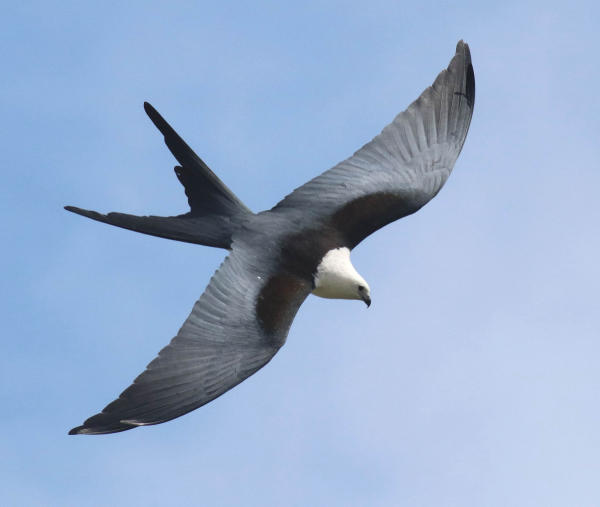
 A Swallow-tailed Kite on the hunt; imagine hundreds of these beautiful raptors in flight. 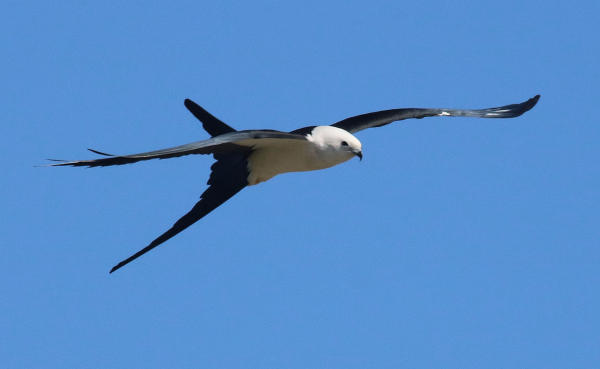 The aerodynamics of a Swallow-tailed Kite in flight are impressive. |
Peter Stangel began this week’s discussion: Hi Paul, “Shark Week” is wrapping up, but here in South Carolina, Kite Month is in full swing – and it’s super exciting! Swallow-tailed kites nest in swamps and riverine forests in good numbers here in the Southeast along the Atlantic Coast from the Carolinas south to the Everglades. About mid-July or so, Swallow-tailed Kites gather in pre-migration communal roosts all the way south through the Florida peninsula. We are blessed to have a couple of kite roosts located just an hour from home and it’s a short migration I love to make. Seeing one or two of these stunning birds is thrilling; seeing dozens at a time is life-changing.
Swallow-tailed kites nest in swamps and riverine forests in good numbers here in the Southeast along the Atlantic Coast from the Carolinas south to the Everglades. About mid-July or so, Swallow-tailed Kites gather in pre-migration communal roosts all the way south through the Florida peninsula. We are blessed to have a couple of kite roosts located just an hour from home and it’s a short migration I love to make. Seeing one or two of these stunning birds is thrilling; seeing dozens at a time is life-changing.
During mid-morning the kites begin to appear at a couple specific fields. They seem to be drawn to these exact sites due to abundant dragonflies and flying beetles (food), plus nearby swamp forests provide night roosts. At first one or two Swallow-tails materialize, then a few more, and on good days dozens or hundreds may show. Last year, more than 200 Swallow-tailed Kites could be viewed simultaneously at the larger of the two fields. Some are distant, but some are so close you can identify the species of dragonfly they are holding in their talons as they wing by.
Plenty of Mississippi Kites join them too, which adds to both the kite experience and the level of excitement. Birders drawn to the spectacle can’t help but revel at the aerial displays. Both kite species pull high-G turns as they swoop and spiral to grab flying insects. Some stoop and pick-off dragonflies perched on the top of tall grasses – so impressive.
Swallow-tailed Kites are now listed as a vulnerable species. The 2016 State of North American’s Birds lists them as moderately vulnerable. We hope the birders inspired at the kite fields will take action to help protect the Swallow-tailed Kites and their habitats. You can check out a great article about Swallow-tails at http://arcinst.org/attachments/stashed_files/STKI_TNC_April_2016.pdf How was your birding week Paul?
Paul Konrad followed with his highlights of the week: This week I enjoyed the opportunity to go birding with two great friends: Kristine Long, from San Jose, California, who is a serious birder who joined me for a Wednesday field trip, and my friend and cousin, Dwight Konrad, who was also visiting this week from Portland, Oregon. While Dwight is a casual birder, he enjoys getting into the country to feel the pulse of nature, and Dwight joined me during Monday and Thursday field trips.
Kristine really enjoys birding in the wide-open prairie landscapes, and this year her favorite birds seemed to be Eastern and Western Kingbirds, Yellow-headed Blackbirds, a Least Flycatcher, Grasshopper Sparrows, a Sharp-tailed Grouse brood with five fledglings and, especially, fledgling Common Nighthawks.
Dwight really experienced the excitement of birding: About 45 minutes into our drive, after checking out many duck broods, Swainson’s Hawks, White Pelicans and other birds, I stopped to identify a flock of sandpipers. They were Long-billed Dowitchers, fresh from their nesting areas on the Arctic tundra. Suddenly a distant flock of sandpipers flushed, quickly followed by a flock of gulls, which is a cue for any birder to check the sky for a hunting bird of prey. Sure enough, two birds sped into view, a sandpiper with a Peregrine Falcon speeding right behind it with primal intensity. That’s when things became very exciting!
As the sandpiper took a quick turn to the north, the Peregrine rose upward in a quick spiral, then initiated a dramatic high-speed dive toward the fleeing sandpiper; and repeated the process three times. Whoo-wee! The falcon pulled up as the sandpiper escaped, but the Peregrine continued to course the shallow wetland and promptly tested a duck and her brood. Ooh, but the ducklings simultaneously dived below the surface of the water with a big splash as the falcon dipped low overhead, then out of sight. What an exciting two minutes that turned out to be!
Kristine and Dwight both enjoyed checking out the fledging Red-tailed Hawks and Ferruginous Hawks I’ve been monitoring. I’ve been checking on the two hawk nests daily and they began fledging last week in sync, with the first, second and third nestlings in both nests fledging in sync day by day. One note on the Ferrug nest: The oldest of the three nestlings left the nest prematurely, as sometimes happens. It spent six days on the ground below the nest where the adults undoubtedly fed it, but it returned to the nest for three days before actually fledging. The Red-tail fledglings are providing nice photo opportunities, but the Ferrugs remain hidden in the high grass surrounding the nest, which is fairly normal behavior for Ferruginous Hawk fledglings.
In addition to the fledging hawks, a few fledgling Common Nighthawks have been exciting to monitor and photograph this week along a remote location I refer to as “the lost road.” It’s amazing how the nighthawks blend in with the color of the gravel road, weathered wooden fenceposts and granite rocks they perch on, and it’s fun to photograph them during a stealthy close approach. I’m not sure who enjoyed the nighthawks more, Kristine, Dwight – or Paul (definitely Paul).
Thanks to Dwight and Kristine for joining me – it’s so fun to spend time with them as close friends, but to share birding experiences makes time together all the more fun. Thanks Kristine and Dwight!
Orchard Orioles dominate my feeding station now, seems like two females, probably a couple males too, but it’s hard to tell. The primary Baltimore Oriole pair left the area almost three weeks ago; another pair visited once about a week later, but for the past week a female has become a regular visitor. I’m convinced that providing grape jelly for the first time this spring made all the difference in keeping the orioles in the area during the nesting season, because last year sliced oranges didn’t attract orioles and no orioles remained in my neighborhood to nest.
The change of seasons has begun for some birds in the area. Several species have begun flocking, including Tree Swallows, Black Terns, Western Meadowlarks, Killdeer, Franklin’s Gulls and Ring-billed Gulls. I was also surprised to see that the large flock Wilson’s Phalaropes had already molted into their gray and white non-breeding plumage. This week was a super birding week – What Fun!
Photos by Paul Konrad
Share your birding experiences with the editors of The Birding Wire at editorstbw2@gmail.com