
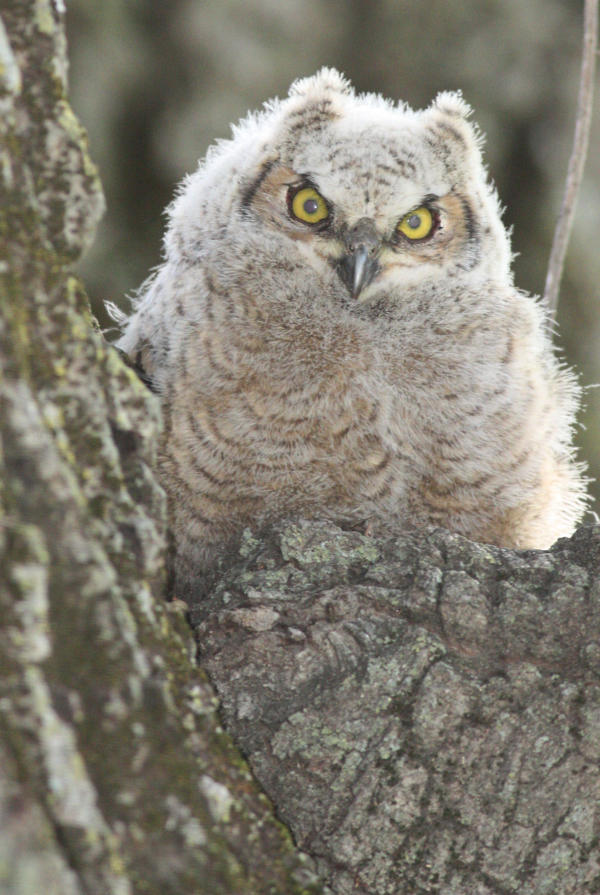
 Great Horned Owl nestling 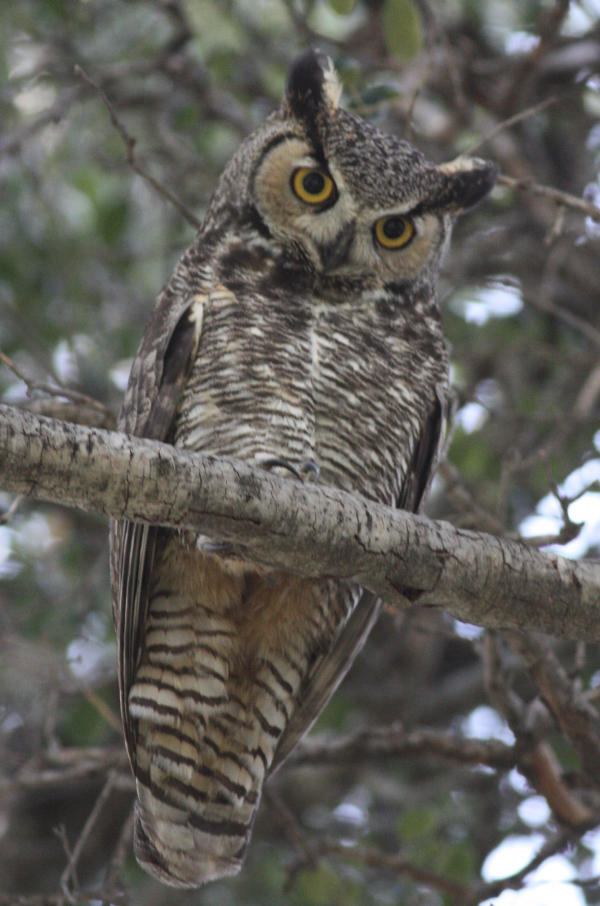 Great Horned Owl |
Named for the two horn-like tufts of feathers on the top of their head, Great Horned Owls are among our most successful, wide-ranging and most adaptable species. One of the largest owls, Great Horned Owls are the only New World members of the eagle owl genus, Bubo, which dominates the Old World continents of Europe, Asia and Africa with 19 impressive species.
These owls are impressive avian predators, and Great Horned Owls’ specialized owl adaptations include: 1) acute hearing that utilizes binocular hearing in which the two ear openings are positioned at different levels on their face, and 2) a facial disc of specialized feathers that focus sound toward the ears; 3) remarkable eyesight that is impressive during daylight hours but most specialized for night activities due to the large eyeballs with large pupils and a high density of rod cells in the retina, allowing them to detect motion in extremely dim light; 4) specialized flight feathers that reduce the sound of these big owls in flight, which is especially helpful when hunting, and 5) their large body size, big broad feet and long talons.
These owls are among the very first birds to begin nesting; often laying eggs in January in warmer climates, but even in northern climes they lay eggs by April. Their commonly heard, deep “hoot-hoot-hoot” calls can be heard during the coldest nights of winter as pairs display in anticipation of nesting. There’s a good chance you’ve seen or heard, a Great Horned Owl recently as they are common and widespread.
Range: Across the Western Hemisphere from Alaska to Argentina, from the Atlantic to the Pacific.
Habitats: A wide variety of habitats and ecotones from northern taiga forests to deciduous woodlands, prairies, croplands broken by woods and grasslands, badlands and desert areas, everglades and bayous – and a variety of tropical forests in Central America and South America.
Mating: Pairs begin calling and displaying during January in many areas, often during the coldest nights of winter.
Nest Sites: Owls do not build nests, but Great Horned Owls utilize the former nests of hawks and ravens, large tree cavities, tree crotches, or the top of broken snags. They occasionally utilize manmade structures including old barns and Osprey nest platforms.
Clutch Size: 2 to 4 white eggs.
Incubation Period: 28 to 34 days; incubation begins when the first egg is laid, causing asynchronous hatching by about two days per egg and providing staggered ages of the nestlings that may vary by a week from oldest to youngest in large broods.
Fledging: About five weeks, but nestlings often leave the nest before they fledge and begin “walking” along large branches adjoining and near the nest. These pre-fledglings are often referred to as “branchers.”
Food: Primarily rodents and rabbits, but in some areas they are known to take a wider variety of small animals and large birds.
Conservation Status: Common and increasing in some areas. Like a number of hawks and owls, Great Horned Owls were not protected until 1972.