
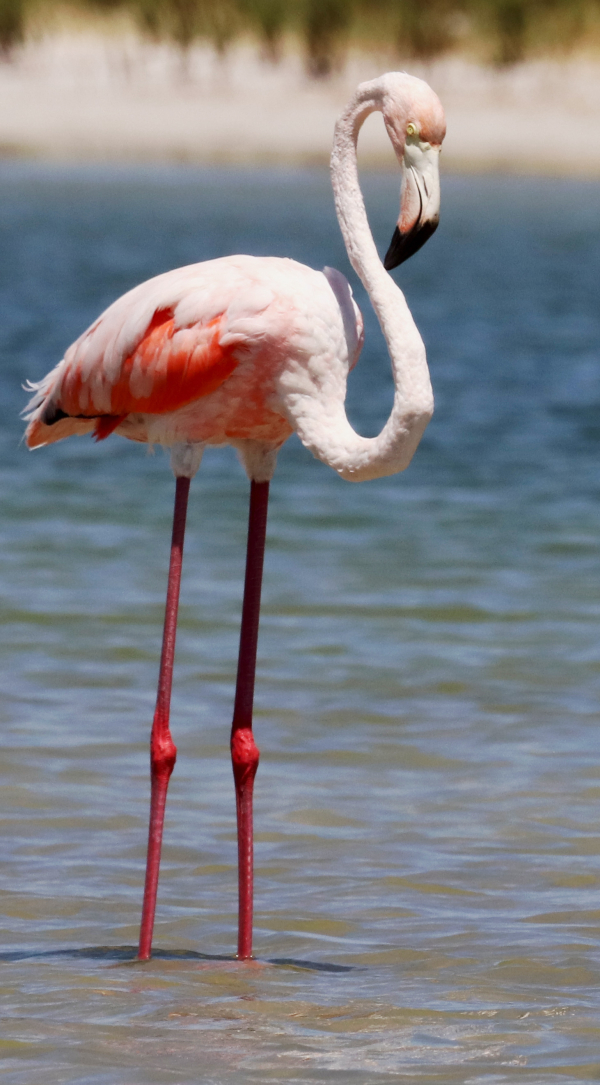
 A total of 101 wild American Flamingos were reported in Florida during a recent survey organized by Audubon Florida (photo by Jim Konrad). |
As we reported in early February, Audubon Florida organized a survey of American Flamingos across the Sunshine State, coordinated through the Florida Flamingo Working Group as part of a larger effort by the Caribbean Flamingo Conservation Group to census all American Flamingos throughout their range from February 18 to 25. Biologists, birders, Audubon members, and other interested people helped to locate and report a total of 101 wild American Flamingos found across Florida.
The largest group of more than 50 American Flamingos was observed in Florida Bay, located between Everglades National Park and some of the northern Florida Keys. Another 18 flamingos were counted in the Pine Island area near the city of Cape Coral, with another 14 flamingos counted at Merritt Island National Wildlife Refuge, with other individuals scattered in other areas of the state.
Dr. Jerry Lorenz, director of research for Audubon Florida, said participants and Audubon Florida are thrilled that flamingos have remained in Florida after being displaced there in 2023 when Hurricane Idalia crossed parts of the Caribbean before continuing into the United States. Lorenz added that 100 flamingos is minimum number of American Flamingos in what appears to be a new Florida population, with more that were not counted during the week-long survey. He also noted that Audubon and other groups are monitoring for nesting flamingos.
Flamingos lived and probably nested in Florida during past centuries, but unfortunately the 19th century plume trade decimated wading bird populations in Florida, when an ounce of feathers was worth more than an ounce of gold. Even after legislation and Audubon wardens protected these birds, extensive draining and ditching of the Everglades and associated wetlands destroyed much of their habitat. Today, with many more acres of protected wetlands and improved water flows in Florida, there should be suitable habitat for the Hurricane Idalia flamingos to survive and thrive here.
As Audubon Florida and other groups monitor American Flamingo numbers, they also remind the public to please give flamingos their space by viewing and photographing from a distance. A rule of thumb is that if you affect their movements or behavior, you are too close. Use binoculars or a spotting scope to view birds from a safe distance. The Florida Flamingo Working Group (FFWG) is a coalition of biologists and conservationists who are working on the conservation and potential recovery of American Flamingos in Florida.
To refer to the original article published on the Audubon Florida website, see More than 100 American Flamingos Counted in Florida During February Census | Audubon Florida