
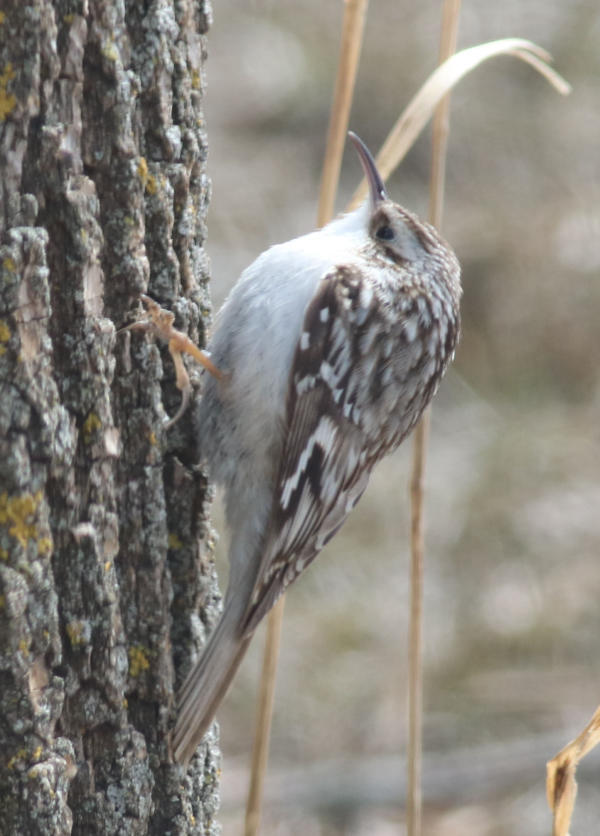
 Brown Creeper |
For the next couple of months, tens of millions of migratory birds will be making their way south to warmer temperate and tropical wintering ranges. Readers of The Birding Wire can play an important role helping to keep these migrants safer during their perilous flights by collision-proofing windows at your home, office and place of worship. It’s a simple, effective, inexpensive action that can save the very birds we revel in inviting in our urban yards locations and birding sites.
When birds see a window, the reflection may fool them into thinking they can fly into the habitat or sky the see in the glass. It’s an understandable, but often fatal mistake. Walk around your house or office and look at the windows, and it’s easy to see how birds are fooled. The larger the window, the more deceptive the reflection. For those of us blessed with homes surrounded by vegetation, our windows are particularly dangerous. Many new office buildings feature large, highly reflective glass that almost perfectly reproduces the surrounding trees, shrubs and sky.
When birds collide with a window they usually bounce off, although they may be killed instantly. They may also be stunned enough that they fall to the ground for a moment or an extended period, making them vulnerable to predators such as cats and dogs. Sometimes they recover.
Almost all birders and most homeowners have witnessed bird collisions with windows. There’s the distinctive “thud” when the collision occurs. Then there’s the heartbreak when you find the flashy fall warbler or tanager lifeless on the deck. It’s only one bird, though, right? Sadly, no. Scientists speculate that an average of 500 million birds die annually in collisions with buildings, primarily windows (and that number may be closer to a billion). About 44 percent of this mortality takes place at personal residences, almost always from window collisions.
Even more regrettably, several species of Conservation Concern due to declining populations are especially vulnerable to building collisions, including Painted Buntings, Golden-winged Warblers, Canada Warblers, Kentucky Warblers, Worm-eating Warblers and Wood Thrushes. Several species showed a disproportionately high vulnerability to collisions, including Dark-eyed Juncos, Brown Creepers and Song Sparrows, among others.
The good news is that we can drastically reduce the frequency of these collisions. In the Link that follows, the experts at the Cornell Laboratory of Ornithology offer practical guidance for preventing collisions. It’s a quick read that could make a very big difference for the birds in our lives.
Two additional points to the great information Cornell provides: First, check out CollidEscape.org (link below) for another attractive way to reduce reflections from your windows and save some energy costs to boot. Their window films can also reduce the aggressive pecking on windows that often takes place during the spring mating/territorial season. They offer solutions for residential and commercial buildings, and guarantee results.
Second, consider talking to the manager of your local plant nursery or home improvement store, whether it’s a family operation or a big box. Ask if they would consider a small display about the issue of bird collisions with windows and sell some of the products from CollidEscape or other companies listed in this feature. These stores are all about serving homeowners and making a profit. Why not engage them in helping solve the problem?
If you need help, or support, ask members of your local Audubon chapter or bird club and see if they’ll work with you. Prepare a little information for them about the scale of the problem (remember, half a billion birds die each year in collisions) and some info on where they can order products such as CollidEscape. You can offer to host a do-it-yourself session to get people into the store and learn first-hand how to deal with the problem.
You can make a big difference for your migratory birds this fall by collision-proofing your windows. Let’s work on this together and make the fall 2018 migration a much safer journey for migrating birds.
Article by Peter Stangel
To learn more about preventing bird collisions with windows, visit https://www.allaboutbirds.org/why-birds-hit-windows-and-how-you-can-help-prevent-it/
Learn more about CollidEscape at https://www.collidescape.org/