
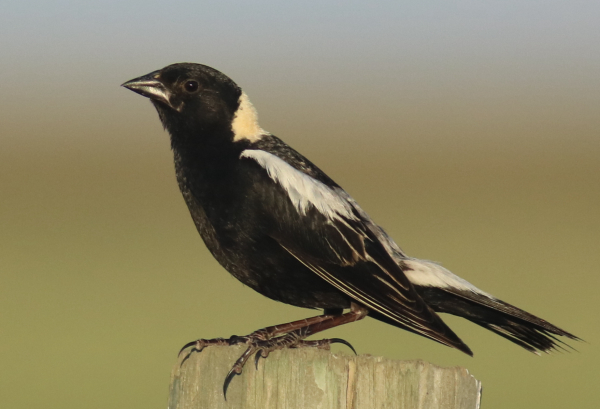
 A male Bobolink on territory in North America last summer is probably wintering in northern Argentina today (photo by Paul Konrad). |
New migration research shows that nesting populations of Bobolinks from across North America (specifically from Oregon, Nebraska, and Vermont) converged within days of one another into an area one?tenth the size of the species’ nesting range in western Venezuela during the non?breeding season. Then, coinciding with increasing vegetation growth to the south, all Bobolinks synchronously migrated farther south to central Bolivia, then continued to northern Argentina and central Paraguay where they wintered.
These migrations were monitored using miniature geolocators attached to individual Bobolinks from the Oregon, Nebraska, and Vermont nesting populations. While wintering in the northern Argentina-Paraguay region, Bobolinks underwent a complete feather molt prior to initiating their spring migration back to respective nesting areas in the grasslands of North America.
Data collected indicates Bobolinks left nesting areas from late August through mid-September, arrived in Venezuela in early October; left in early November, arriving in Bolivia in mid-November, and continued to Argentina a few days later.
The study shows extreme mixing of different nesting populations in staging and wintering areas due to relatively smaller regions of grasslands and agricultural areas in South American staging and wintering areas where they fed on grass seeds, rice, and sorghum seeds.
The results suggest that the Bobolinks' southbound migration is broadly constrained by the availability of food. The species’ non?breeding distribution has been shaped by the seasonal changes of South American grasslands. This is the first documentation of individual birds from across a continental nesting range exhibiting matching seasonal timing during their post?nesting southward migration.
For more information, the research publication is provided at https://onlinelibrary.wiley.com/doi/full/10.1111/ddi.12080