
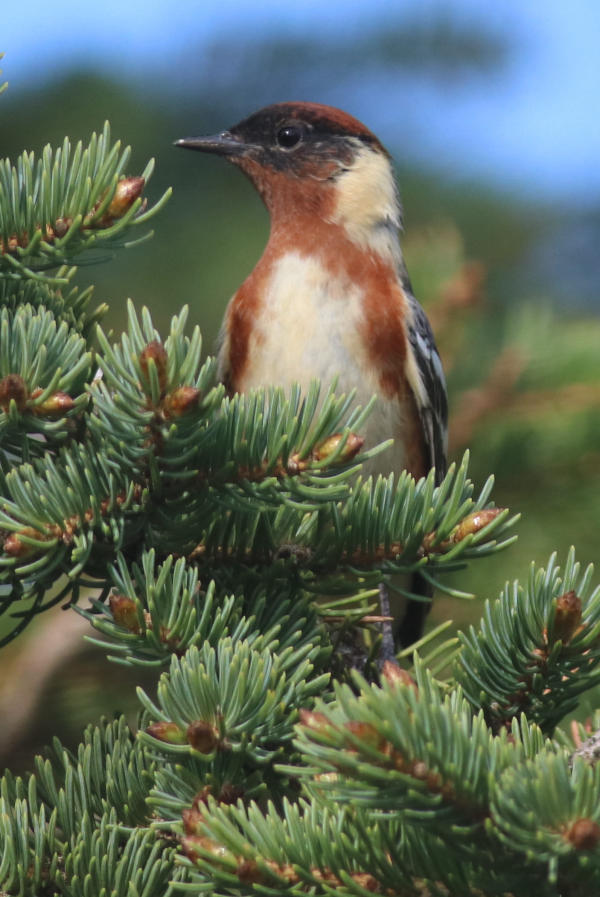
 Bay-breasted Warbler |
With the late afternoon sun streaming through the green longleaf pine needles bathing the grasses and ferns of the forest floor with a golden glow, I could hear an adult Red-cockaded Woodpecker calling nearby, and any second it would land at its cavity, less than 30 feet away, where it would roost for the night. With good fortune, it would linger at the cavity entrance just long enough for me to see the color bands on its legs, adding to data we were collecting on this endangered species. Suddenly the ground started to shake.
Earthquake? In North Carolina? Then I heard the rumble of diesel engines. Roaring down the road behind me were three big tanks. These weren’t the little SUV-sized tanks that you see in front of the Veterans of Foreign Wars building. These were hulking, ship-sized behemoths. Perched in the top of each tank was a soldier, who waved as they passed. Not a surprising event at all, if you are doing bird studies on Fort Bragg, near Fayetteville, North Carolina.
I was a guest on the base, contributing to research on Red-cockaded Woodpeckers that flourish on Fort Bragg, as they do on many other Department of Defense bases. The passing tanks were just one of several unique experiences that I enjoyed that week, working in close proximity to our nation’s military.
Vast Resources for Birds
The Department of Defense manages about 25 million acres in the United States. That’s about one-third the land protected as National Parks or National Wildlife Refuges, and an area the size of Kentucky. The vast majority of this land is, of course, restricted for use by the military for training and other purposes. Although most of these bases may be “out of sight” for birders, they definitely shouldn’t be “out of mind” with regard to their value for conservation.
The Department of Defense has a long legacy of natural resource conservation, but their bird conservation efforts took wing in 1991 when this agency joined the Partners in Flight program, an international effort focused on conserving migratory birds in the Western Hemisphere. The Navy was the first to sign on, followed shortly thereafter by the Air Force and the Army.
The Military’s Bird Conservation Mission
According to their website, the Department of Defense Partners in Flight program “sustains and enhances the military testing, training and safety mission through proactive, habitat-based management strategies that maintain healthy landscapes and training lands.” In practice, this means surveying bases to find out what birds are present, in what numbers, and at what times of the year. All this while understanding the habitat needs of species, monitoring populations to detect upward or downward trends, and helping to ensure that populations of birds remain healthy.
For example, the military’s natural resource managers work hard to ensure that species under their stewardship don’t become legally Threatened or Endangered. This is important for the long-term survival of these species and also helps ensure that military training activities are not impacted by the legal requirements associated with Endangered Species status. The military’s bird conservation activities are guided by a strategic plan, which addresses all areas of concern for birds, from habitat conservation to avoiding bird strikes by aircraft.
Birds on Bases
A review of the military’s bird conservation priorities will lead any birders to grab their binoculars. Fort Riley, Kansas, includes tens of thousands of acres of native tallgrass prairie habitat that supports one of the largest known populations of Henslow’s Sparrows. Navy bases in Puerto Rico and Cuba harbor mangrove habitat for warblers such as Northern Waterthrushes during the non-breeding seasons. Some of the best streamside vegetation in California is on Camp Pendleton and Vandenberg Air Force Base. The forests that hug the Santa Margarita River, which runs through Camp Pendleton, shelter about 50 percent of the entire nesting population of Least Bell’s Vireos.
The Panama Canal Zone, originally controlled by The Department of Defense, was turned over to Panama in 1999. Through the efforts of Partners in Flight and other conservation groups, much of this area’s vast tropical forest was protected or added to the Parque Nacional Soberania. This is good news for the millions of migratory songbirds such as Prothonotary and Bay-breasted Warblers that migrate through this geographic funnel each spring and fall. The Upper Panama Bay is also a critical site for migratory shorebirds.
In the southeastern United States, extensive pine ecosystems on military installations provide essential habitat for such exciting birds as Bachman’s Sparrows, Brown-headed Nuthatches, Swainson’s Warblers, and Red-cockaded Woodpeckers.
More than Habitat
Protecting and managing habitat to benefit birds is just one role for the military. Their strategic plan also includes using radar to track bird movements. This technology has benefitted conservation by helping to identify bird migration routes and stop-over sites, and is used locally to help aircraft pilots avoid flocks of birds during take-offs and landings, when most bird strikes occur.
The military’s Bird Aircraft Strike Hazard (BASH) prevention program works continuously to improve flight safety. The Department of Defense has also invested in long-term bird monitoring studies that help track population trends and pinpoint causes for increases or declines. Military satellites have been used to track birds outfitted with transmitters and have revealed important information about migration routes and wintering sites. This technology was used to help identify where in South America wintering Swainson’s Hawks were being poisoned by pesticides, for example.
Opportunities for Birders
Some military bases allow access to birders. The Department of Defense Partners in Flight website (www.dodpif.org) provides information about several locations and also includes bird checklists where they are available for individual installations.
Article by Peter Stangel
To learn more about the Department of Defense Partners in Flight program, visit their website at www.dodpif.org For more about Department of Defense natural resource programs see http://www.dodnaturalresources.net/