
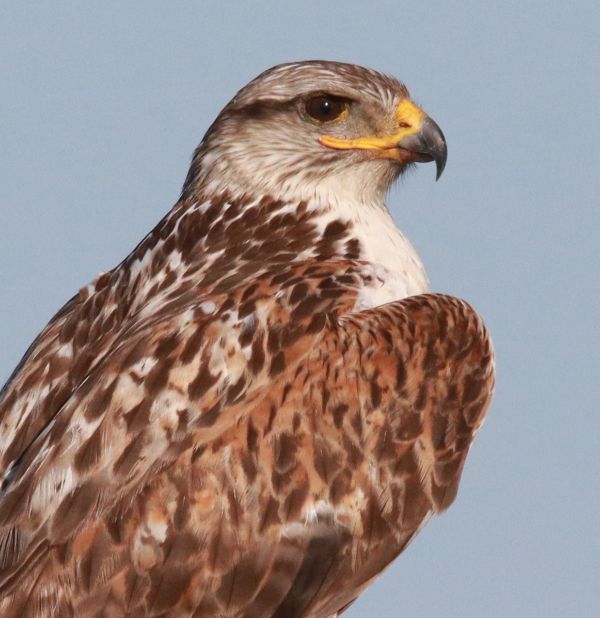
With some extra time to go birding and travel to neighboring states over the America 250 holiday break, I have a wealth of information and photographs to share with you! Rather than recounting the highlights in chronological order, I'm going to start with an exciting outing I especially enjoyed last weekend, when I checked on the most productive duckling producing marsh in the area on my way to monitor the now-fledging Ferruginous Hawks – 3 of them, although I only saw 2 fledglings and both adults in their nesting territory Saturday evening.
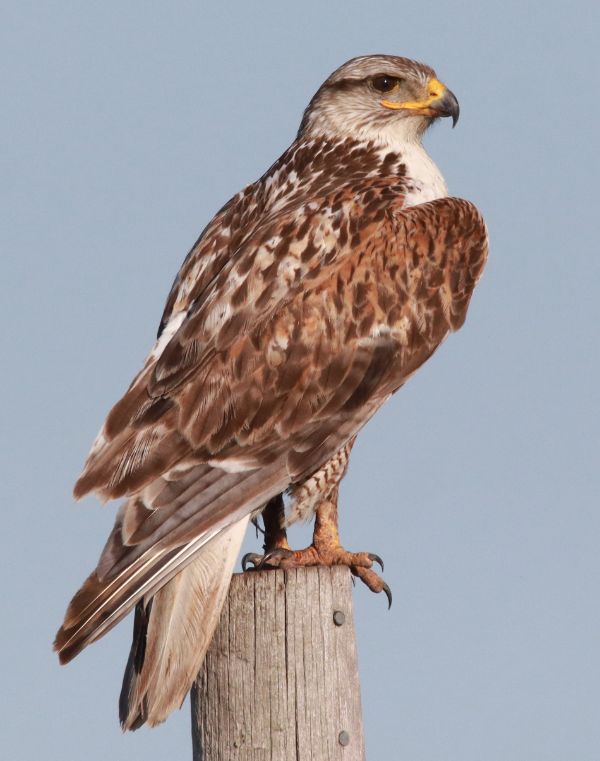
As always, I hoped for a chance to photograph 1 or more of the biggest hawks in North America, but it was hot and the raptors didn't budge from their distant perches. I left reluctantly, but it was somewhat early and the farther I drove from the location, the more I knew I would return in about 40 minutes – just in case a hawk repositioned nearer the road. As I returned, from a half-mile away I could see one of the hawks was perched on a stout fencepost near the little-used farm road. The first question that came to mind: Was it an adult or a new fledgling?
As I turned west, toward the low sun, I checked with binoculars and saw it was one of the adults, but it would be just a silhouette in any photos I took from the east side of the hawk. It would be necessary to pass by the adult Ferrug to get on the sunshine side of the bird for a primo chance at taking a tip-top photograph. It would be tricky, but never fear; if this was the same pair of hawks that nested here previous years, the adults were both very accommodating when I needed to pass by them on the road. I double-checked my camera settings and pre-focused on an adjacent fencepost, then began driving slowly down the very right side of the gravel road, keeping faith that the big raptor would trust my advance.
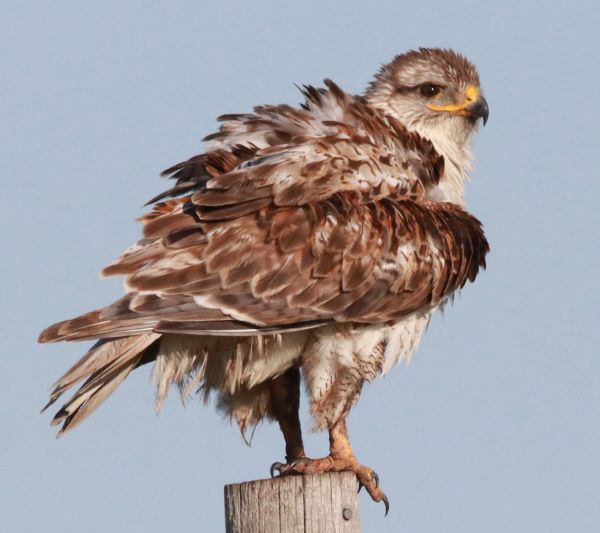
Indeed, the hawk calmly watched me pass by and after progressing a safe distance past the Ferruginous Hawk, I slowly turned the front of my car in a 70-degree angle toward the opposite ditch, stopped as I turned off the ignition and raised my camera into my open window. I quickly focused on the hawk and took a couple quick photos before appreciating how remarkable this regal bird of prey was as it stood clearly magnified in my zoom lens. The hawk showed no concern, so I settled in to see if the "prairie eagle" would provide an alternative pose. Head turns were all it offered, until it bent forward slightly and began a flurry of feather ruffles, a normal maintenance movement to get its feathers positioned just right; but in this case I wondered if it wasn't also a matter of refreshing the warm air within its plumage on this hot summer evening.
Two fledglings were perched on different tree branches, and there was no sign of the other adult, and after another minute or so the big adult before me took flight to circle behind me and land on a hay bale in a recently harvested alfalfa field – a prime rodent hunting habitat for the fledglings to learn to hunt on their own during the next couple weeks. Other raptors were on hand too, including 4 Swainson's Hawks and 4 Red-tailed Hawks positioned along the way to the Ferrug nesting territory.
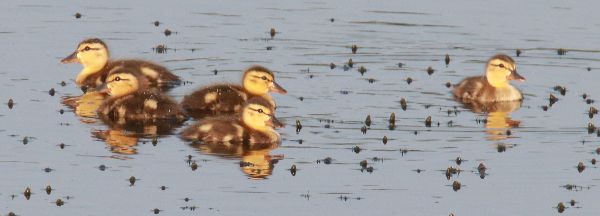
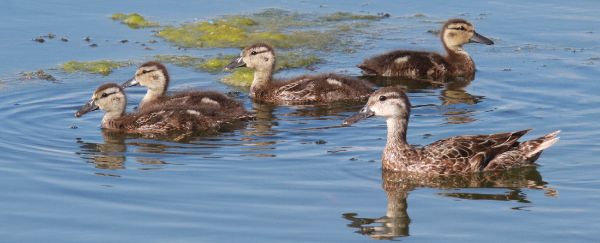
Ducklings Galore – On the way back to my office, I spent a little more time at "Lar's Marsh," where a variety of ducks were raising broods of ducklings – 13 broods to be more exact! The shallow marsh is about a quarter-mile long and half that size wide, and there were 3 Mallard broods numbering 9, 10, and 3 ducklings, 1 Wood Duck brood with 8 ducklings, and 4 Blue-winged Teal broods with 3, 8, 7, and 9 ducklings; along with a brood of 8 Redheads, a brood of 3 Northern Pintails, a female Gadwall with 10 newly hatched ducklings, a Northern Shoveler brood of 7, and a female Green-winged Teal with 4 ducklings. That's a total of 93 ducklings composed of 8 species in 1 small Dakota marsh! What fun I have enjoyed observing and photographing the recently hatched ducklings led by the adult female.
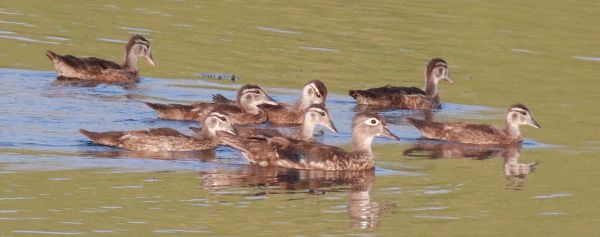
The very first shorebirds began returning from Arctic nesting sites to this area of the northern Great Plains by July 1st, including 4 Least Sandpipers, 2 Baird's Sandpipers, and 2 Long-billed Dowitchers with a scattering of several Greater Yellowlegs. Locally, the first Killdeer hatchlings were spotted July 5th, when 2 "pairs" of Common Nighthawks were also observed doing flight displays, often in tandem. Molting male Wood Ducks are showing up in area wetlands too, an annual occurrence after their participation in the mating season is complete. Other male ducks are molting too, but I expect they were part of the local nesting population.
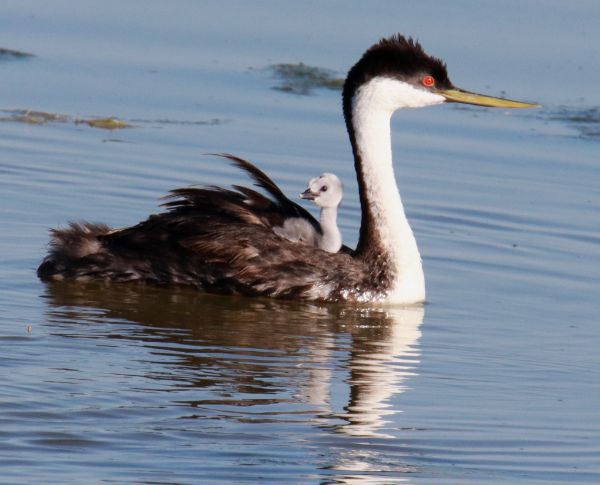
An hour south and east across the border into South Dakota, Hecla Marsh provided observations of some different birds, including 2 pairs of Black-necked Stilts and a 10-day-old hatchling that slipped into view on the edge of cattails at the far east side of the marsh. There were also a few White-faced Ibis and scattered Great Blue Herons and Great Egrets, along with 4 Mallard broods and 2 Blue-winged Teal broods at the east end. In the west-central area of the marsh there was a Northern Shoveler brood and another brood of Blue-winged Teal, along with 4 Western Grebe families with hatchlings ranging from recently hatched to 3 or 4 weeks old. But the biggest waterfowl action was in the east bay of Hecla Marsh, a small open area that just happened to be full of female ducks and their ducklings. In all, there were 5 Mallard broods, 3 Blue-winged Teal broods, and 1 Northern Shoveler brood, with the shovelers being the most trusting for photographs. Along the drive to Hecla I also sighted 2 single adult Bald Eagles, along with a few Swainson's Hawks, Red-tailed Hawks, and a couple male Northern Harriers.
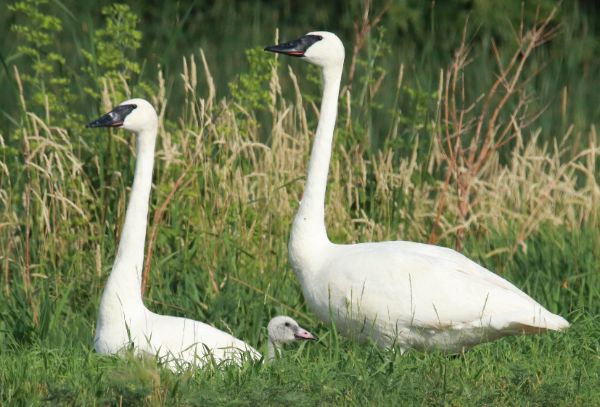
Family Time – During the holiday break, I visited family members too, and during my recent afternoon visit with Katy, Jeff, and Anders (my niece and nephews), north of Minneapolis I enjoyed hearing Northern Cardinals singing in the company of American Robins as the sound of American Goldfinches filled the area. They also have an active Osprey nest east of their home, with a second active Osprey nest to the west; and there are Trumpeter Swans and Mallards nearby too. While visiting my nieces and nephews in Fargo, I observed 2 American Kestrels nearby, along with a Killdeer, but it was the sunflowers I gave the family a month earlier that caught my attention at their home. I thought the sunflowers were at their peak when I bought them, but Krista's recently acquired green thumb seemed to double the number of blooms and the plant's size. Krista was also quite happy to report that American Goldfinches feed on the seeds produced after flowering, and she explained that after the seeds are eaten, if you clip the dead flower off, a new one will develop – good to know. She even pointed out a female goldfinch as I was interacting with the boys – Wyatt, Noah, and Blake – along little Ruby.
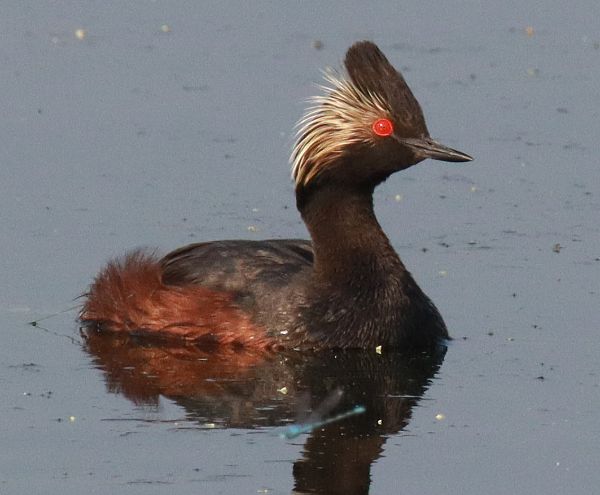
In this week's issue, you can read about my yard bird experiences with new fledglings dominating my feeding station in the Backyard Birding article, and check out the new Burrowing Owl action photos and the story behind them in the Bird Photography feature. But wait, there were a number of surprise sightings in my yard in addition to the fledgling action, starting with 2 new Baltimore Orioles. On July 3rd, a new darker female Baltimore Oriole visited for tastes of grape jelly, also returning the 4th and 5th. Plus, a new yearling male fed on jelly the afternoon of the 9th of July! That day a pair of Northern Flickers were searching for ants in the grass just outside my front door, which made it very fun to view them so close without binoculars. A male American Goldfinch and a White-breasted Nuthatch were other premier yard visitors, and the male Ruby-throated Hummingbird remains among my summer favorites when it frequents my nectar feeder. I hope you enjoy this mid-July issue of The Birding Wire, and please join us again next Wednesday! Until then, enjoy the summer birds you encounter and search for at favorite birding areas and new locations.
Article and Photos by Paul Konrad
Share your bird sightings and photographs at editorstbw2@gmail.com