
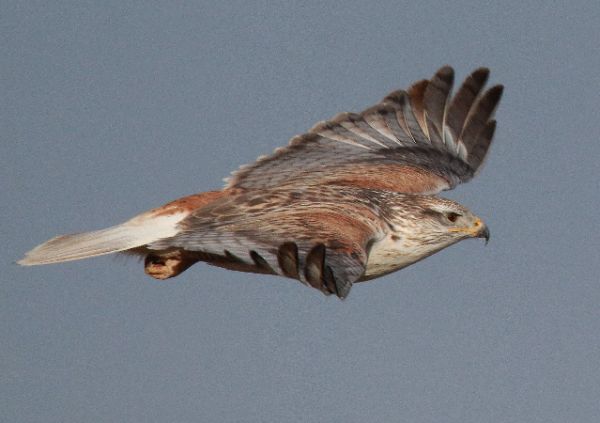
Mid-afternoon of the second of 4 snow days I broke away with the hope that roads were good enough to check on the Ferruginous Hawks, and while the roads were clear and dry, the hawks were both available on territory. The female was standing on the top of the low hill the pair seems to prefer and I saw the male flying toward the tree he sometimes perches in, but his flight angle took him to the ground where I lost sight of him. As I continued south past the nest, I suddenly realized the male was flying by my car with a branch in its beak, headed past me to the nest – a very fun sighting to witness.
The male deposited the branch on the nest and as I parked at my usual distant observation point, the male took flight in a half-circle that elevated to a perch near the top of the nest tree. I jotted down a few notes, and as soon as I looked up again the female took flight, headed directly toward the nest; indeed, she landed on the nest. After waiting a while, I drove back toward my office with the chance to get a closer look at the nest as I drove north, and the female Ferrug was lying low in the nest, which will be her position when egg-laying or incubating begins. Seeing the female standing on the nest Sunday, and lying on the nest Thursday was exciting.
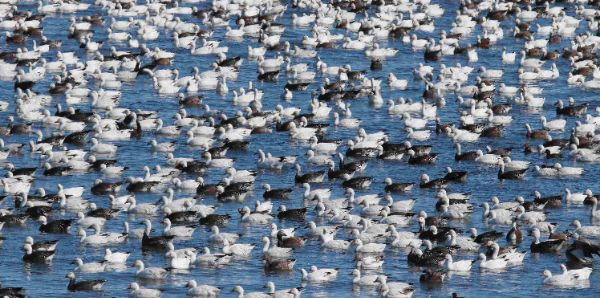
Without knowing what to expect during this initial birding drive in the midst of the 4-day snow event, I was happy to see more avian action than usual for the week – primarily among geese. Tuesday there were very, very few geese in the area and I figured the big migration had passed, but during this break in the weather there were clearly 3 areas where more than ten thousand Snow Geese were flying in miles-long flocks – 4 miles, 6 miles, and 10 miles long! There were undoubtedly many, many Ross's Geese mixed within the Snow Geese, and there were hundreds of White-fronted Geese on hand too – maybe more than 1,000 at a marsh mixed with as many as 2,500 Snows and Ross's Geese.
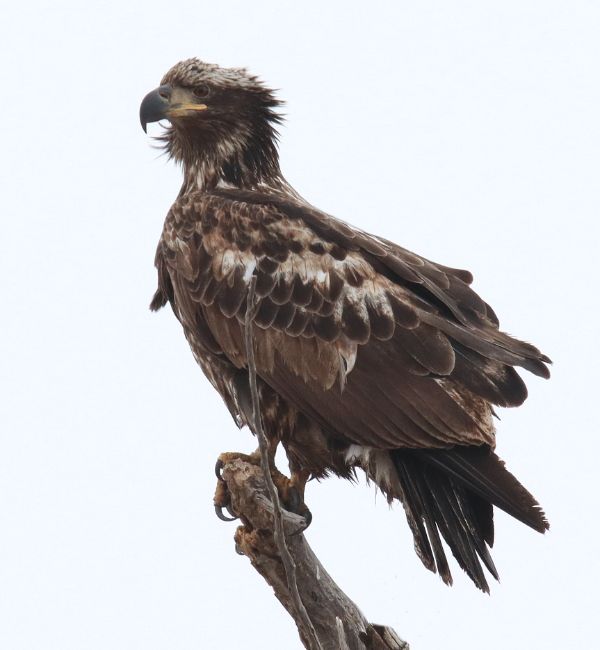
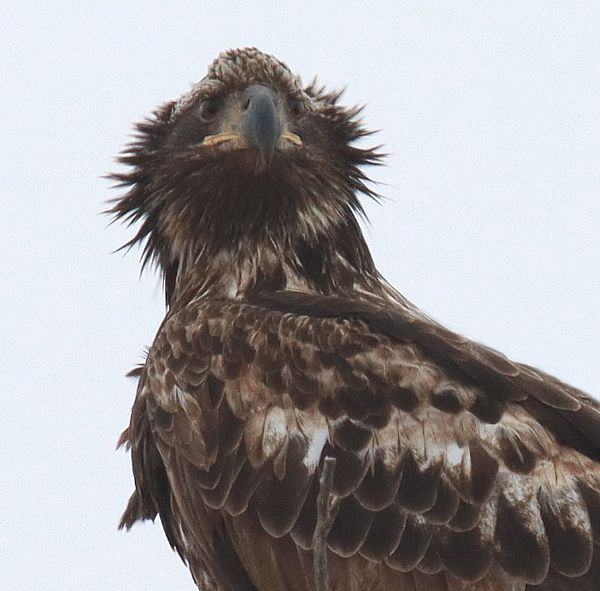
While the abundance of geese on the move was another unexpected surprise, so were the 14 Bald Eagles assembled in an old grove of trees surrounded by seasonal meltwater shallows where a concentration of migrating flocks ducks had assembled – Northern Pintails, Northern Shovelers, Green-winged Teal, and scattered Mallards. Although it was exceptionally overcast, I had to try to take a few photos of some of the eagles, and one young eagle in particular caught my attention as its nape feathers formed something of a crown, such as I can't recall ever seeing before. Also, sprinkled among the many ducks were 23 Tundra Swans in sub-groups of 2 or 3 – all these birds in a location where I've never seen a bird before.
A total of 14 American Kestrels and 19 Red-tailed Hawks also showed a migration surge, plus there were 4 Northern Harriers and scattered Western Meadowlarks. Three new species included the first male Belted Kingfisher, 2 Mourning Doves, and a Common Raven. The raven was 9 miles northeast of home, 16 miles closer than my previously closest raven sighting a few years ago. Lone Common Ravens continue to press farther into the open plains of Dakota, still creating very rare sightings that are even rarer the farther west you go (they originate from the forests of Minnesota or from the forests of Manitoba).
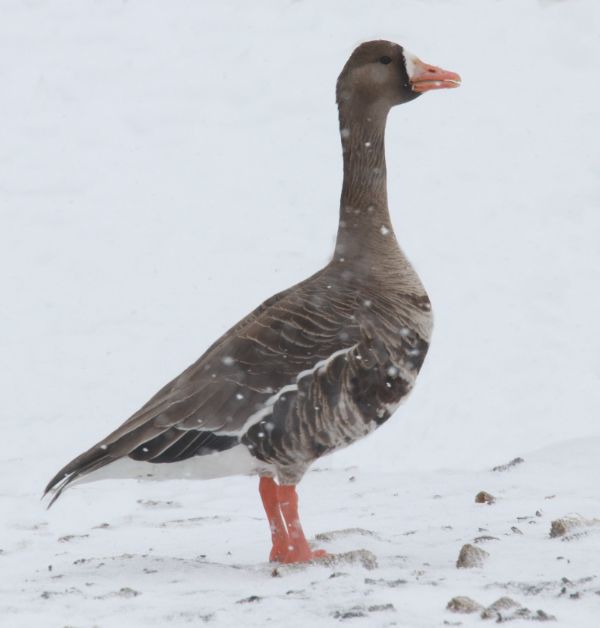
Friday, just before the snow began to create a whiteout, I drove north to check on the geese I saw at Rainy Marsh, but the first sightings began a mile from home and continued for 3 miles – scattered flocks of Lapland Longspurs numbering between 20 and 50 per flock. Other songbirds along my route included a flock of about 15 Tree Sparrows, scattered Dark-eyed Juncos (usually near a tree grove), and 3 huge flocks of Red-winged Blackbirds. There were also several Killdeer, 3 Greater Yellowlegs, and 2 more Mourning Doves. The first flock of geese included about 80 Snows flying east above Carlson Lake (7 miles north), and a mile north of there a similar-sized flock of White-fronted Geese was feeding on the edge of a harvested cornfield. About 4 miles north of there, several hundred Snows and White-fronted Geese were feeding next to a marsh where another 100 geese were resting – a very impressive group.
At Rainy Marsh it was a surprise to see a sheet of ice covering most of the shallow water, but a mixed flock of migrant ducks kept the far side of the marsh open – mostly Northern Pintails and Gadwalls, with some American Wigeons too. Most other ducks along my route were Lesser Scaup, Ring-necked Ducks, and a few Mallards. Raptors included 5 continuing Bald Eagles at the shallow swan and duck marshes 2 miles east of Rough-leg Prairie where there were 4 American Kestrels, 1 female Northern Harrier, and 1 Red-tailed Hawk (with a flock of Snow Geese flying overhead). Other raptors sighted along the way included 2 more American Kestrels, 2 male Northern Harriers, and 2 more Red-tailed Hawks.
During the rest of the afternoon the Big Snow continued throughout the night, with 15 inches of new snow dumped by Saturday morning, but with the sun shining and the paved roads clear by afternoon I drove to the Hecla Marsh to check on eagles – there was only 1 to be seen – and all the new birds were in South Dakota: 1 Turkey Vulture and 5 Great Blue Herons at Hecla Marsh and at Sand Lake Refuge there were 8 Lesser Yellowlegs with a couple Greater Yellowlegs and a surprise flock of 16 Dunlins with 2 associated Baird's Sandpipers and 1 Pectoral Sandpiper – all new for the year except the Greater Yellowlegs! An interesting observation I haven't seen before was the yellowlegs following and feeding in close association with Blue-winged Teal – as many as 7 yellowlegs following 1 or 2 teal, picking at tiny invertebrates that the teal appear to have been stirring up in the shallow water adjacent to the shore.
There was a female Belted Kingfisher, an adult Cooper's Hawk and a Northern Flicker along the way, with at least at least 4 Bald Eagles at Sand Lake and 2 Short-eared Owls about 5 miles to the east where there was also a trio of Northern Harriers hunting a nice expanse of grasslands. Male Ring-necked Pheasants became especially active the last hour of sunlight, as did flocks of geese flying from the south to feeding fields closer to the Dakota border. And passing by the Ferruginous Hawk nest after sunset, I was excited to see the female Ferrug on the nest; standing, then lying as if to roost there.
During a Sunday birding drive the abundance of ducks and geese kept me active locally: After all, there were a few hundred Snow Geese mixed with Ross's Geese and White-fronted Geese just a half-mile south of home on the shore of Melody's Marsh. New species included 6 White Pelicans, which was quite a surprise, a lone Double-crested Cormorant plus a small flock later, along with 6 Tundra Swans at Bobby's Lake 2 miles north. By late afternoon there were more geese in the area than I've seen this spring, including a huge cloud of geese that flew from Dean's Lake 1½ miles northeast of home, another cloud of geese 5 miles northwest, a thousand feeding 2 miles south, and a half-thousand feeding ¼-mile south!
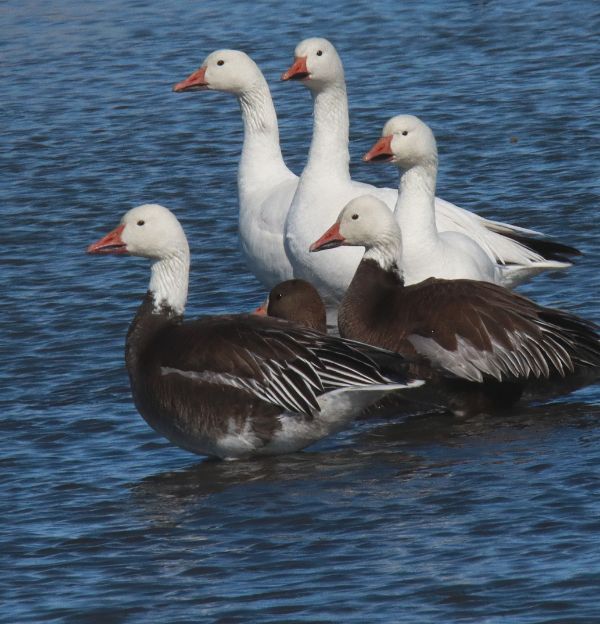
Most of the flocks were made up of Snow Geese, but there are obviously more Ross's Geese in "white flocks" now; the Ross's were fairly obvious by sight and especially obvious when checking my photographs. The flocks of Cackling Geese have been gone for about 10 days, as have Canada Geese that don't nest here – only the Giant race of Canada Geese remains. It is also interesting to note that there are many flocks of Canvasbacks in the area, but no Redheads over the weekend. Sunday there was a Ferruginous Hawk standing on a low hill west of the nest, the male I think. There were also 2 Red-tailed Hawks present almost 2 miles south of the Ferrug nest – 1 might have been the Krider's dude.
Yard Birds: A female Purple Finch was a new bird on Day 1 of 4 consecutive days of snowfall (Wednesday through Saturday morning), but she didn't return after 2 feeding station stops. Friday as the snowfall increased, 2 Blue Jays were present and calling in my front yard. Although juncos have been foraging below the feeders regularly, for the first time since their arrival a couple weeks ago a Dark-eyed Junco perched at the tube feeder to collect a shelled sunflower seed time and time again – perhaps pressed to do so by the quickly falling inches of snow that covered the ground.
Sunday an adult male Cooper's Hawk appeared to be on the hunt, and the first male Red-winged Blackbird of the year perched in the feeder-side ash tree a moment. I also had some vocal late night birds reveal themselves – a Great Horned Owl hooted a few times at one point and a flock of Snow Geese flew over about midnight. Aside from that news, the regulars continue to forage at the feeders or in the yard, including Red-breasted Nuthatches, White-breasted Nuthatches, House Finches, Downy and Hairy Woodpeckers, and occasional American Robins in the yard.
As the weather continues to roller-coaster its way through spring, nature continues to pulse across the plains on feathered wings where I am planted and document the birds that move within sight and within the range of my daily meanderings. Over the past week the area has been re-covered by a white blanket of wet snow, even as some birds heartily increased in numbers with ample surprises along the way. Perhaps it's the surprises that keep us birding week by week, season after season. The birds and surprises have sure kept me interested my entire life – today, and yesterday, and tomorrow! A daily dose of birding is kinda like taking a daily multivitamin – it's a part of maintaining good health and a happy outlook in so many ways. Enjoy your week!
Article and Photos by Paul Konrad
Share your bird sightings and photographs at editorstbw2@gmail.com