
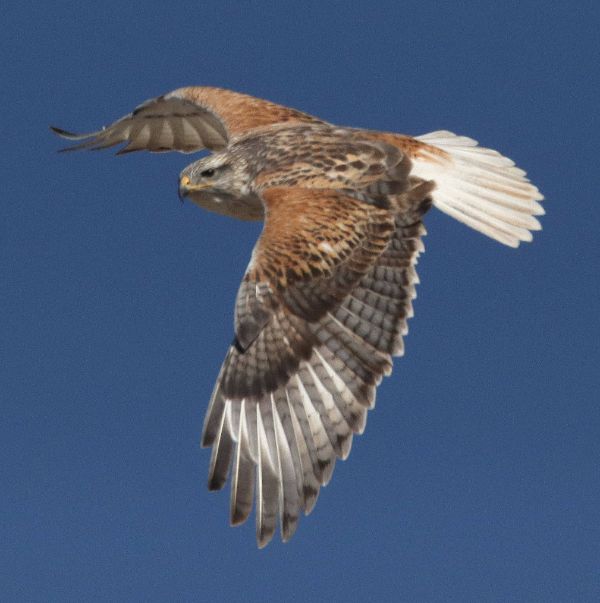
A personally exciting observation Thursday afternoon filled me with thrills every time I thought about it thereafter. As I was approaching a vacant hawk nest I've had my eye on south of my office, a Ferruginous Hawk suddenly appeared, flying directly toward the nest that a pair of Ferrugs checked out last March. The apparent male landed on the nest as I passed by to continue my drive to a lookout spot a half-mile away. I didn't see the regal hawk carrying a stick to add to the nest, but it spent a few minutes standing on the nest, then repositioned to a nearby tree before taking flight. As it banked, I saw a second Ferruginous Hawk flying low to the east, where it landed on a low hilltop – a slightly larger female – How Exciting!
The male wasn't far behind, and as it was gliding low above the female, she hopped upward to extend her talons toward the male, who dropped it legs toward hers, then landed next to her. What would happen next? I thought there was a good chance copulation might happen. The female hopped next to and past the male, followed by the male walking next to and past the female. They stood in tandem a couple minutes until the female took a short flight, landed, and seemed to be searching or inspecting the ground. She took a very short flight and searched again, then flew toward the nest. That's when I could see she was carrying a branch, which she deposited on the nest as she alighted and stood on the nest platform for an extended period.
The male was inactive on the low hilltop as I watched the apparent Ferruginous pair another 5 minutes. I couldn't see the female anymore and wondered if she laid down in the nest, or did she take a sneaky flight that evaded my attention. Turning my vehicle back north, I passed by the nest with intensely focused eyes, but I couldn't see a hawk's head so I kept moving to avoid any attention to my passing car. This was a monumental spring observation, personally, partly because I observed similar behavior at this nest last April 8th, but the pair didn't stay. But wait, that's almost a month later than this pair arrived, on March 12th; at least that's when I first saw them. They could have arrived March 8th without me knowing.
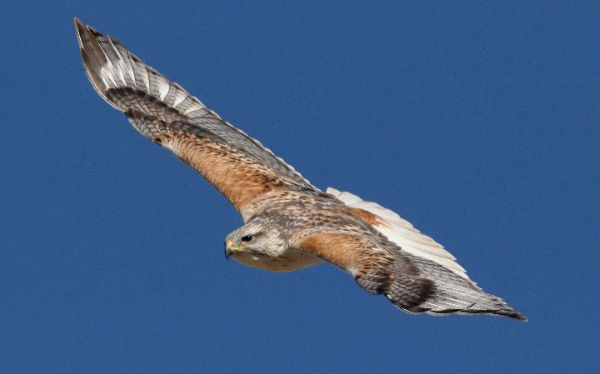
Last year's pair was only present during one observation of many that spring, on April 8th, then moved on to a preferred location somewhere else. That happens during the earliest nesting activities of these hawks, with nest site selection an important part of the pre-nesting period, when pairs sometimes check out a number of existing large stick nests and the territory surrounding them. But this spring I've been hoping a pair of Ferruginous Hawks, perhaps even the same pair, would commit to using this nest and the surrounding hunting territory. Now, here was a pair in the earliest throws of the nesting cycle! I was thrilled, but in a somewhat detached way because I needed to see a full commitment from the pair to stay. I hope the pair will claim the site, which would be clear when the female lays her first egg and begins incubating. Needless to say, I would be back to check on the pre-nesting activity at this potential nest site – the next morning!
Before I made it home, the wind tripled in strength, intensifying to 40mph and continuing through the night – not to mention that a rain/snow storm was expected within 48 hours. Would the Ferruginous persist? Hope so! That afternoon drive began with a look at an adult Bald Eagle perched less than 2 miles south, a male Northern Harrier flying north, and a second adult Bald Eagle flying north after another mile. Farther along, there was a large flock of Northern Pintails, a similar-sized flock of Snow Geese, and a few small groups of Canada Geese under 6 birds in number. Oh, and the first 7 territorial male Red-winged Blackbirds were spaced across a small cattail marsh.
Earlier in the week, Wednesday afternoon I drove to Fargo with the plan to check on the possibility of finding a Northern Saw-whet Owl – and looking for other "eastern birds" like Northern Cardinals, a Red-bellied Woodpecker, maybe even a Pileated Woodpecker – all longshots, but that's what I was on the lookout for along the Red River woods south of the big city. A couple Fargo birders have been reporting Saw-whets pretty regularly, and a recent post reported 5 during a single birding effort. I checked every spruce tree that's been planted (years ago) in the area of Orchard Glen and Forest River parks, glassing spruce trees up and down from different angles, but didn't find any of the small wintering owls – hey, I tried.
But I did hear Northern Cardinals singing along with sightings of Downy Woodpeckers, Slate-colored Juncos, Black-capped Chickadees, White-breasted Nuthatches, a Blue Jay, and a third-year immature Bald Eagle on a branch overhanging the Minnesota side of the river. Earlier, near my family's neighborhood a male American Kestrel was perched, seemingly on territory considering I've seen one there 3 of my last 4 visits. Another bird of interest reported about 70 miles northwest of home was a male Varied Thrush, a species I find especially attractive, and with the weather so krazy lately, I decided to see if this rare western thrush (rare in Dakota) would be observed by others before I committed to trying to locate it (no other reports were forthcoming).
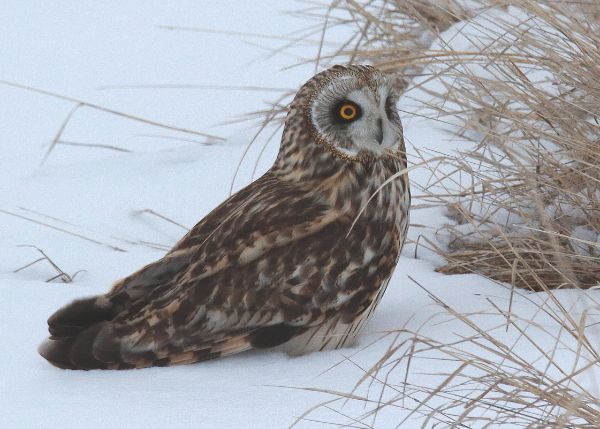
The previous afternoon, after publishing last week's issue of The Birding Wire late Tuesday, I drove 8 miles south before making a U-turn to return home. After not seeing a bird the entire drive, before me there was a Short-eared Owl flying near the road – no, there were 3 owls! I literally drove by the spot only a few minutes earlier; so once again, it emphases how "timing is everything," especially related to birds and birding. Two of the owls seemed to be interacting up the hill from me, but I was closest to the first Short-eared Owl, so stopped and watched to see what the owl would do next. That's when I was really surprised, because the owl not only flew in my direction, it actually landed next to my car, about 25 feet away on a swatch of newly fallen snow.
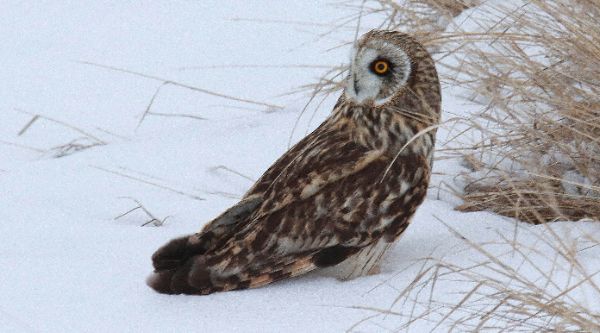
Unfortunately, there was a tall ragweed plant obstructing my view, so I took a quick photo just to show how close it landed before trying to back up a few feet with my fingers crossed. The owl appeared to be more concerned about the other owls, or at least one of them; it was standing behind a couple bunches of grass as it watched the owl in flight. I took a couple photos of the owl before it repositioned a few feet by hopping over the snow to stand behind a bigger bunch of grass. That's when the owl of concern approached on the wing, which flushed the first owl and the 2 flew southwest, possibly in a chase mode.
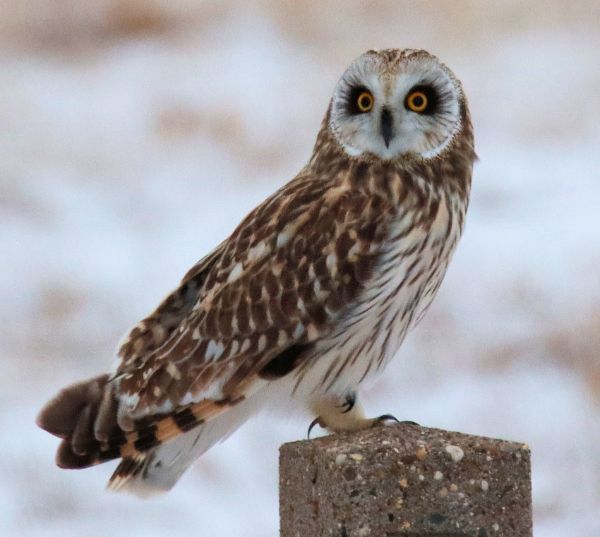
In response, I drove forward to photograph the owl that was perched on a cement marker a quarter-mile ahead. It looked quite different from the first owl and it was interesting to photograph and observe it for a couple minutes before it took flight. In retrospect, I'm somewhat convinced that the first owl that perched near my position, the bird that appeared edgy and wanted to hide behind grass – it might have decided to land near my car because it thought the other owl would be less likely to approach the white car on the side of the road. Anyway, all the owls vanished thereafter, and I haven't seen any since.
More Hawk Sightings: Excited to see if the new pair of Ferruginous Hawks were still present after the excessively strong winds that gusted to nearly 50mph overnight, I arrived near the nest site about 10am Friday. I was excited to see the female standing on the top of nest platform facing west, even though I didn't see the male in the area as I watched from quite a distance. I checked on a Bald Eagle nest in the area, where a pair of eagles was perched next to the nest that appeared to be built up in recent days – it's located about halfway to the hawk nest. I returned to the Ferrug site at 11am, only to see the female in exactly the same position standing on the nest, but this time the male was perched about halfway up in a nearby tree, which was especially exciting that they were still at the nest and on territory. The surrounding region is an expansive native prairie area that hopefully is filled with voles, ground squirrels, and pocket gophers to encourage the pair to stay.
About 5pm I returned to the nest site again and saw the male standing on the low hill northeast of the nest from quite a distance, but didn't see the female in the area. I was keeping my nest checks shorts and sweet so I didn't tip off my interest in the nest and hawks, and to minimize any concern from the hawks during this sensitive period when they are settling into nesting mode. I checked back Saturday noon, a few hours after a new snowstorm began, the male was standing in what appeared to be the exact same spot as I left him 19 hours earlier – a good omen – but the female was nowhere to be found. I drove a mile south before making a U-turn and heading back north, and during those 40 seconds the female flew in to join the male, and they were standing within a foot of one another on the low hilltop!
I slowed down to verify what I was seeing through binoculars when I saw 2 wing flaps, which was either copulation or a repositioning move, and I'm leaning toward the former. These hawks were behaving in all the typical ways of a pair on territory, adding nest material to the nest, interacting, and hopefully producing the first fertile egg soon – which could be followed by 2 to 5 more. For such a big raptor, Ferruginous Hawks will lay as many as 6 eggs in a clutch, although between 3 and 4 is more average. The female will begin incubating as soon as the first egg is laid, and the male will take his turn each day or night – but I'm getting ahead of myself again. For now, they are on territory with a fine nest ready to receive a big white egg with small brown specks.
Earlier, on my way to the nest, I was really surprised to spot the first Ferruginous Hawk of the day perched in the highest branch of a tall cottonwood tree 6 miles south of my office. Considering its size and position high in the tree, I expected it would be a Rough-legged Hawk, but with binoculars I could see its white chest (which also suggested a plains Red-tailed Hawk), but I certainly didn't expect it to be another Ferruginous Hawk – bingo! Closer to home there were several pairs of Canada Geese spread across the fields and 3 miles south a flock about 25 geese included mostly Canadas, a few Cackling Geese, and a single White-fronted Goose. Aside from these birds, there was an abundance of Horned Larks scattered along the snowy route.
The sighting of the third Ferrug, a bird on the go no doubt, made me think twice, and thrice about extending my drive to check on the 2 traditional Ferruginous Hawk nests 20 and 25 miles west-northwest of my office, so when I checked the weather radar it looked like the snow was letting up in that direction, so I turned west. I intended to drive that way the following Monday, after the storm when the sun would beam across the plains again, but I couldn't hold back in spite of the ongoing snowfall. The road was still good, and I observed 3 raptors along the way to the hawk nests – a male Northern Harrier, a Rough-legged Hawk, and a Merlin – all hunting in earnest in spite of the windy snowfall.
Alas, there were no Ferruginous Hawks to be seen to the northwest yet, and it was disappointing to see that the more southern nest had been destroyed by wind sometime during the past month, with almost half the tree broken to the position where the nest was built – a big loss. I also checked a Bald Eagle nest about a mile from the northern Ferrug nest, but there was no sign of eagles either. Upon my return drive, another male Northern Harrier flew up from the side of the road, as did many, many Horned Larks. Oh yes, and initially as I approached the active hawk nest to the south at noon, the first Western Meadowlark of the year took a short flight before me. The first meadowlarks and robins of spring are always moments to celebrate, and this year the first robin advanced 6 days before the first meadowlark.
It snowed all day Saturday and most of the night while a 30+ mph wind blew the white stuff into a frenzy as temperatures dropped – not exactly an attractive offering to the Ferruginous Hawk pair that was contemplating whether to keep the nesting territory in the south fork. After a snow plow cleared the way, Sunday afternoon I checked for the hawks without luck, as expected considering the intense wind and blowing snow; but it wasn't a true indicator if they were still on territory. After all, the 2 small groups of Canada Geese that I did see were lying low on the edge of cattail marshes – and I only saw 1 small flock of Horned Larks, which was very different from the preceding day as the snowstorm was beginning.
Monday was a beautiful blue sky day, but still pretty cold, and I waited until mid-afternoon to drive south to check on birds, including the Ferruginous pair. No geese, a few scattered Horned Larks, and 2 single Western Meadowlarks were present along the way, and I was relieved to see that a Ferruginous Hawk was perched midway up a tree adjacent to the nest – yeah! I figure if it was still on territory and "guarding" the nest after the weekend storm, the hawks can make through anything. At a time when the weather put a hold on spring migration, the hawks have added some incentive to keep a daily watch to the south, something I usually do a number of times a week, but now with renewed purpose. I'll keep ya posted on how things progress.
Yard Birds: A new species appeared Thursday: 2 American Tree Sparrows. They took a quick look at my feeders and moved on. Later, the feeder-avoiding female Hairy Woodpecker searched the ash tree's bark for appetizers, and the male Downy Woodpecker visited the suet feeder, as usual. A new bird arrived Friday morning too – a male Hairy Woodpecker that started at my ash tree and committed to my seed feeder. The 2 American Tree Sparrows stopped by too, and at one point they displayed and sang together in unison. The 2 species of nuthatches and House Finches present, and the female Downy Woodpecker visited the seed feeder a few times later in the afternoon.
Saturday my feeders were unusually vacant, but Sunday the nuthatches and House Finches were active at the seed feeders, and the male Hairy Woodpecker returned to the seed feeder a number of times. The male Downy Woodpecker fed at the suet feeder too. My feeding station was pretty quiet Monday, but 2 hours before sunset I heard a Blue Jay nearby, and about an hour before sunset the female Hairy Woodpecker checked the ash tree near the feeders for morsels, but ignored the feeder foods available, as usual. Two American Crows were flybys above my yard too. Tuesday as I was completing this issue, the female Hairy Woodpecker plied the trunk of the ash tree, and
As I look out my bay windows, it could be December or January rather than the second half of March with the strong south wind blowing light snow into a flurry. It seems the earliest migrants have reversed their course, but they will return soon with temps returning to the 50s by Thursday. The Ferruginous Hawks have been the story of the week, and I sure hope they will spend the nesting season at their recent hangout. It's an exciting time in the Northern Plains as nature pulses between winter and spring and back again. I hope you are enjoying the birds in your yard, your neighborhood, and in the surrounding landscapes – the week ahead could be a good one for migrating birds to appear in force. Enjoy your week!
Article and Photos by Paul Konrad
Share your bird sightings and photographs at editorstbw2@gmail.com