
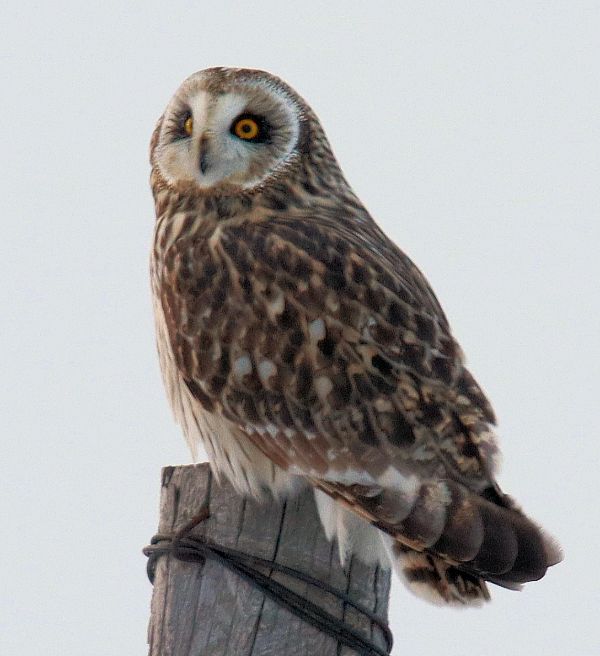
In last week's "Owl Addendum" I described seeing 5 owls the previous Monday, and I followed-up by checking on them Tuesday about the same time – a half-hour before sunset. The first bird I encountered 6 miles south was a Rough-legged Hawk, the first I've seen in 10 days in that area. But I didn't have much faith in finding the Short-eared Owls – wrong – thankfully. A half-mile farther south was the first Short-ear hunting on the wing, and after it faded out of sight, I turned north and there was a second Short-ear perched near the road! It allowed me to approach and photograph it in the fading light, which was quite a thrill.
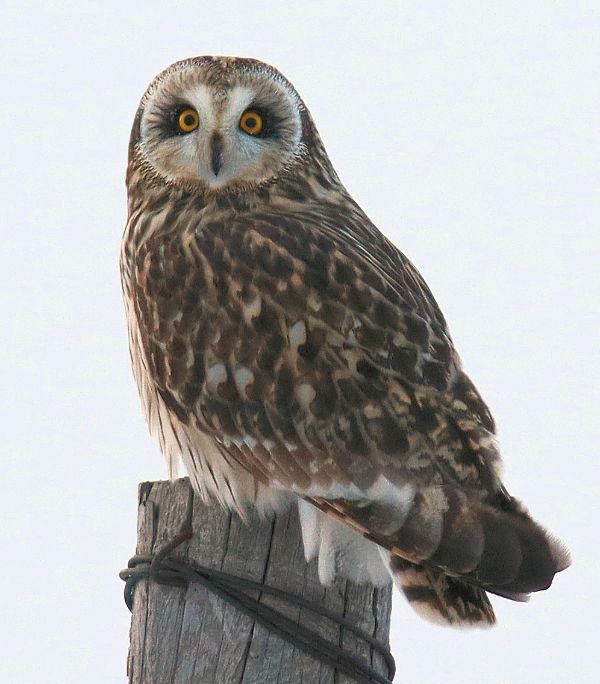
I returned toward the first owl and found it hunting on the wing above a new area of grassland slightly farther south, where it provided a nice photo interaction, plus a chance to photograph it perched. I was a bit surprised to see how cold this owl was acting, puffing up its feathers in an exceptional way in spite of the fact that it was 18 degrees warmer than the previous sunset (-1 vs +17 degrees), but I also felt some empathy for my amigo.
These Short-eared Owls can be quite endearing, especially when you have a chance to spend time in their company as they rest or hunt from a low perch. They seem to have a friendly nature and they are quite cute, but these are fairly anthropomorphic thoughts, and in reality these owls are first and foremost predators – pretty good predators considering the number of voles I saw them catch in an hour's time.
Which brings up the other enjoyable thing about Short-ears: To have a chance to watch them during their low flights above the grasslands. Short-eared Owls have very long wings that give them a unique look, and their flights make them look so buoyant and light-weight; as they fly their wing movements give them a "bouncy" quality at times. But without a moment's notice they can turn as quickly as any bird can move, changing direction right or left, up or down, at 45-degree and 90-degree turns in a split second, only to bounce along, and circle, watching and listening for movements on the ground or snow, and turning this way and that – I find the activity to be especially pleasing to watch.
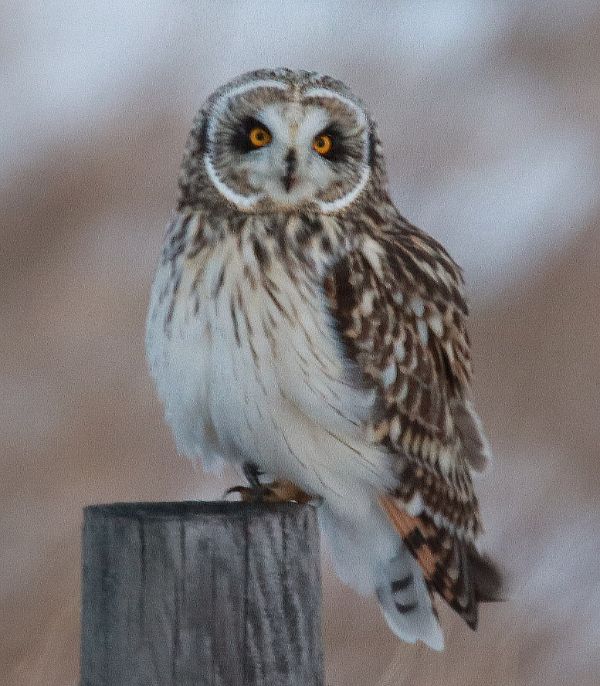
On my way home, near dusk there was a tight flock of more than 150 Snow Buntings 3 miles south of the office acting like they were alighting at a potential ground roost, then flying up again and landing a couple times at the same spot again. But the best long-distance sighting was of another Short-eared Owl, this one just ¾-mile south of home on the southwest side of Melody's ice-covered marsh! I obviously had good luck on this little birding drive, considering I only drove 7 miles south and didn't check any side roads, where there may have been other owls, hawks, or birds.
Wednesday's day blizzard produced a white-out like I haven't seen in a long time, with snow blowing horizontally at more than 30mph at ground level that limited visibility to 45 yards at times, yet there was a clear blue sky overhead. This went on for most of the day, but at 3:30 the ground-level view broke through, and I could see trees ½ mile away pretty clearly. It was still very windy and cold, but I was game to check for owls, even though I expected they should be in protected cover, or maybe they evacuated the seemingly inhospitable landscape the area became due to the intense polar weather front dropping down from the farthest north point of the planet.
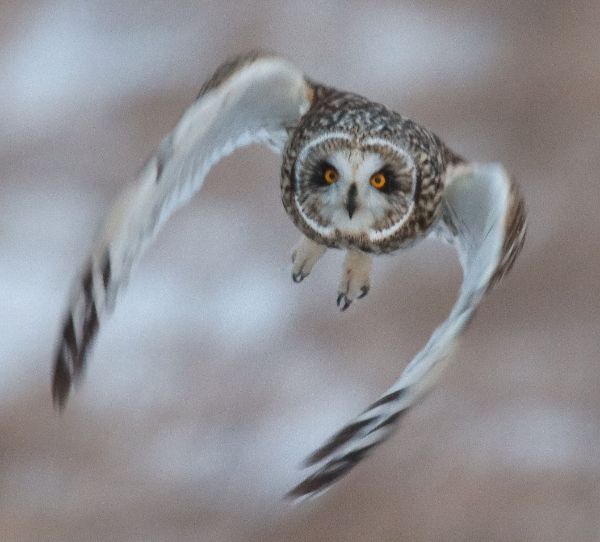
Indeed, no owls were in the area, or surrounding grassland areas, but I did see a small flock of 4 Sharp-tailed Grouse, a flock of 4 female Ring-necked Pheasants, and a lone male pheasant. On my return home, I was surprised to see a tight flock of maybe 100 Snow Buntings in the same location as the night before – were they roosting or feeding?
Thursday, with a free day open and the promise of the coldest night of winter ahead (–22 degrees with an 18mph wind that created a –42 degree wind chill), I decided to retrace the drive I took to Jamestown 8 days earlier, and to check back on the owls 7 miles south before and after the drive north. I retraced my route through areas where I found 5 Rough-legged Hawks scattered along the way, but while driving north I only saw a flock of 10 Snow Buntings; and while returning southbound, just 1 rooster Ring-necked Pheasant. Although no owls were active during my 2 checks 7 miles south, there were more than 200 Snow Buntings in the same location as the 2 previous sunset periods, and with a better look at their activities, I now had the impression they were feeding en mass; but flying up and repositioning occasionally in a tight flock and landing in an even tighter flock.
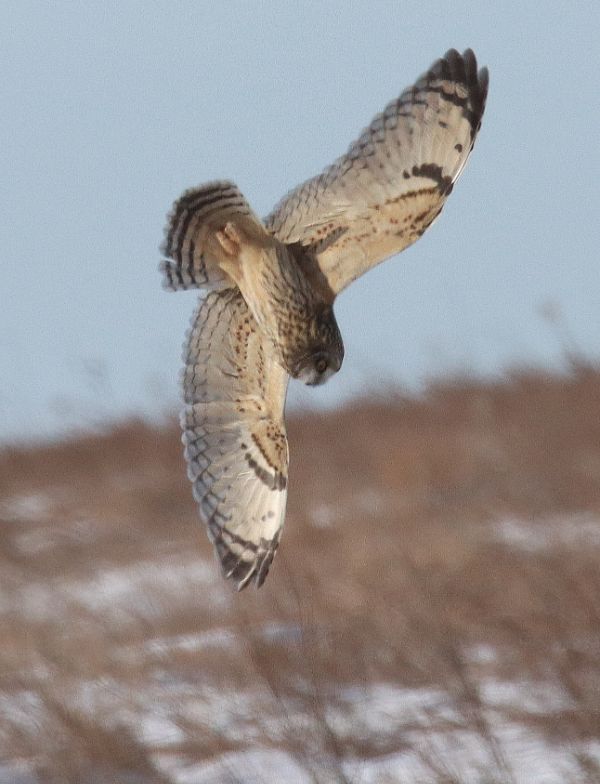
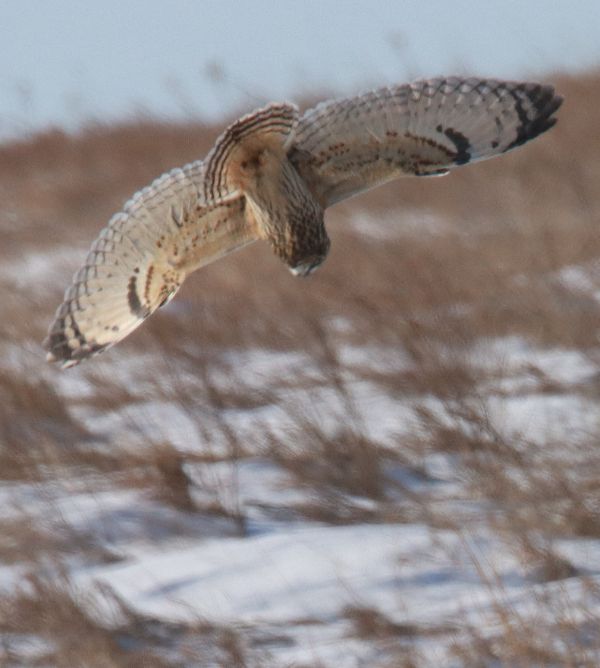
Friday: Although the temperature was still –17 degrees, there was only a light wind and sunshine galore Friday morning, so after working an hour in the office I couldn't hold myself back from checking on the potential of birds any longer. Realistically, the potential was remarkably low, and dropped even lower after passing through the area where Short-eared Owls were active Monday and Tuesday without sight of a feather moving. But I kept driving south and bam, a Short-ear was perched on a low post near the road 5 miles south of the Monday-Tuesday hotspot. And then there were 2, and even 3 Short-ears – hoo-wee!
I spent the next hour observing and trying to photograph the hunting and perched owls above the hilly grasslands. It was fun, and it was a bit frustrating, with the owls tantalizing me with would-be photo ops, but not following through with a good opportunity time and time again. That's part of the challenge of getting a good species photo – in this case, many challenges. One thing that stood out during my observations was that the owls occasionally perched close to the ground, or on the ground – to rest, but also to get out of the light but super-cold wind I'm sure.
What was a bit frustrating about the owls was that as they hunted on the wing, each as a single bird, so I would follow one owl's flight through my camera lens, waiting for it to turn in my direction, but almost always the owls turned away from my position. Part of the problem was the direction of the wind; the owls tended to face into the northwest wind, but the sunlight was coming from the south-southeast, which meant the back-half of the owls would be nicely highlighted, but the front including the face would be shaded. It also seemed my usual ability to anticipate an owl's moves and turns wasn't in line with what they actually did. Eventually, I realized I had one more pair of traits in my favor – perseverance and persistence.
Even so, the owl action settled down after about 90 minutes; perhaps because they had eaten enough small rodents by then. So, having learned more about these open-country owls during my observations, and getting a few interesting photos in the process, I headed back north. Five miles north, as I reached the mixed grass-and-marshlands where I found the first trio of Short-eared Owls earlier in the week, I slowed to a crawl, and darned if there wasn't a Short-eared Owl flying low ahead of me. In fact, it quickly made an attempt to capture a likely vole in those first moments when I was so excited to see it. A moment later I could see a second Short-ear, and eventually a third – all in sight at the same time!
This observation was a breakthrough after not seeing an owl during an earlier search of the area (within 2 hours), or during Wednesday and Thursday visits to the area when winds raged up to 30mph across the area. Earlier, I wondered if the 3 owls hunting 5 miles south had repositioned from this grassland, but that obviously was not the case. Now I ascertained there were at least 6 Short-eared Owls in the areas south of the office (plus a flock of 7 Sharp-tailed Grouse).
With the sun beaming through a clear blue sky Saturday morning, I was excited to check back on the Short-eared Owls, but was surprised not to see a bird during my 75 minute search for owls and other birds. Oh wait, I did see 2 distant Sharp-tailed Grouse a bit farther southwest of the 12-mile owl hunting area. Of course, I hadta check back later in the day, and at the 7-mile trio's territory, sure 'nuff, there was a Short-eared Owl, and then 2 owls! I spent some time with the duo, hoping for photo ops, but broke away to check on the 12-mile owls, which were missing again. Back to the 7-mile location, an owl was immersed in a hunting flight, and a second appeared, but essentially I struck out on the photo level on this sunny day when the temperature warmed to +1.
Sunday morning the temp warmed to –13 when I checked for owls, but they were collectively no shows at the 7-mile and 12-mile locations, and during a late afternoon check no owls were evident. Monday afternoon warmed to +18, but no owls were taking advantage of the tropical weather – have they vacated this vacation spot? (ha!) I know cold weather was all too widespread across much of North America, and I hope everyone is fine as we bid adieu to January pronto.
Even closer to home: Friday an adult male Cooper's Hawk caught my attention as it flew low to the ground a couple hundred feet from my office; I found it perched low in a tree 40 feet from there and watched the little male until it saw sparrow activity and took flight. I followed in that direction, but didn't see it again. Nonetheless, it was interesting to see the hawk's initial low flight – no more than a foot off the snow-covered ground.
That morning, a male Hairy Woodpecker visited my seed feeder, being the first woodpecker I've seen in a week. After being away from my feeder view from 11:30 to 3:30, a couple late afternoon visits to the suet feeder by a male Downy Woodpecker was nice, but it was eventually displaced by a male Hairy Woodpecker. The usual feeder visitors continue to be at least 2 Red-breasted Nuthatches, 2 White-breasted Nuthatches, and an occasional small flock of House Finches. But there was one more surprise Tuesday afternoon as I prepared to publish this issue – a sprightly little Redpoll explored all my feeders – hooray! What will the fun days of February bring in the way of avian surprises and fulfilling observations? Good Luck!
Article and Photos by Paul Konrad
Share your bird sightings and photographs at editorstbw2@gmail.com