
While birding at Hawk Ridge on a peak day of fall migration last Wednesday, at least 871 Sharp-shinned Hawks were sighted by the official counters as a variety of birds migrated overhead. While common during migration in the northern woodlands, this small forest species is rarely seen in the open plains where I’ve been spending most of my time the past decade. As a result I have very few photos of Sharpies, and with so many Sharp-shins flying by at Hawk Ridge during perfect September weather I hoped to get a good representative photo or photos of the species. While there is always a chance for a good photo opportunity at Hawk Ridge, the migrating raptors tend to be flying high and fast on the best migration days, and I’ve been skunked there before on the Sharp-shinned front.
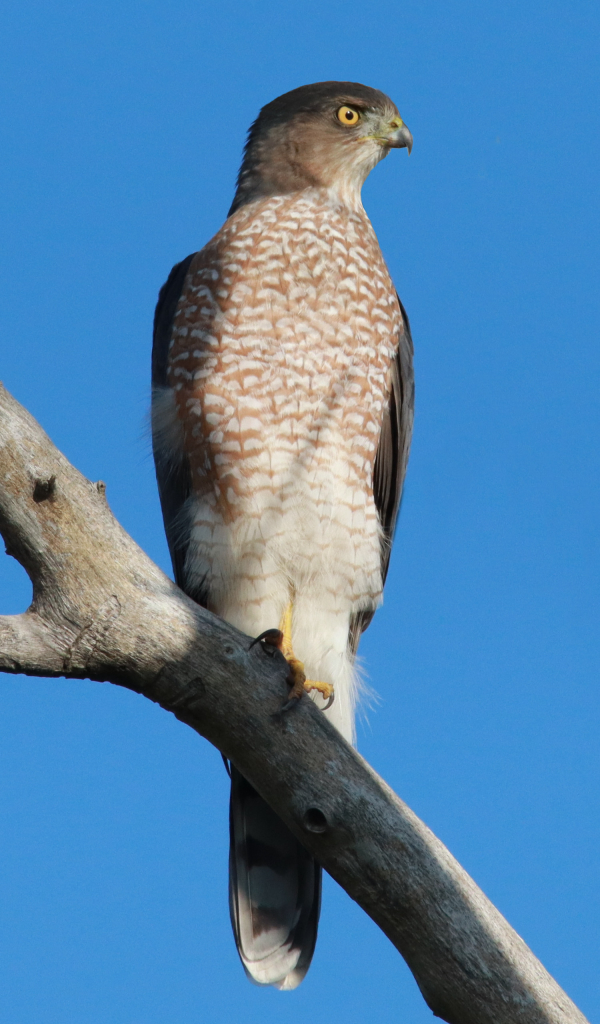
A rare opportunity to photograph a Sharp-shinned Hawk during a migration break in the open plains provided my first portrait of this woodland species (600mm zoom lens, f-8 aperture, 1/2000 shutter speed, 800 ISO).
|
With so many hawks in the sky, you would think it would be a layup to get some good photos, and I did get 2 representative images of a young Sharpie in flight, which was a breakthrough. In fact, I used 1 of the photos to introduce my Editor Afield article in this issue. To be honest, I came away from the Duluth hotspot wishing for more on the photo front, although the migration experience was remarkable overall! But Saturday afternoon, when I least expected it, I sighted another raptor in the infamous skeleton tree near my friend Jason’s farmstead. That tall bare tree is where I have photographed a Merlin that I recently shared with you, as well as a Copper’s Hawk, Swainson’s Hawk, Red-tailed Hawk, a Red-headed Woodpecker family, a Northern Flicker, and Mourning Doves that I can think of now. What could this bird be?
As I approached and took a closer look with binoculars, it surprised me to see it was a large adult female Sharp-shinned Hawk, perched on a barkless branch with clear blue sky behind it. Like the Merlin, it was perched high in relation to the rarely used road, but knowing how the Merlin photos turned out quite well, I slowly idled my mobile blind into position. It was prime photo time at 6pm, and the beautiful, somewhat angry-looking hawk stood erect among the skeleton branches and permitted me to photograph without apparent concern, more intent on the big picture surrounding her. If the photos turned out they would be my best of the species, and considering the images I was seeing on the LCD screen on the back of my camera, they should look fine on my computer screen.
With perfect photo conditions including the direction and angle of the sunlight coming from behind me, I used my usual standard preset aperture of f-8, which provided a corresponding 1/2000 shutter speed that was more than fast enough for taking sharp portrait photos, but also fast enough in case the Sharpie stretched its wings or tail, or took flight. I spent about 5 minutes in the presence of this trusting hawk, waiting, watching it scan the surrounding landscape and skyscape. Then, without a hint of motion, she was off, flying in a species-specific flap and glide motion below tree level, although she was in the open far from trees for much of her flight in a southwest direction. Gracias Amiga!
I hesitated a few moments, left to wonder: What is it about this barkless tree on the edge of a grove with an expansive view that attracts so may birds? Maybe I just answered my own question with that sentence’s description of the site. Then too, it was testament to a level of luck, timing, and the importance of checking back to locations where birds seem to habitually perch as we search for the next interesting bird to photograph. You never know what interesting bird will be perched there the next time you visit. Enjoy all your fall photo activities!
Article and Photographs by Paul Konrad
Share your bird photos and birding experiences at editorstbw2@gmail.com