
Last Thursday was so much fun it was like a birthday wish coming true – beautiful weather, remarkable birds, blue sky, picturesque water that provided a stage and theater setting for the fluid action of a dancing loon. You may wonder: Really? A dancing loon? But if you were there with Andy, Craig, and yours truly, you would appreciate that there is no better way to describe the action we witnessed and were thrilled by – the swirling, twirling action of the bird, the sweeping wings, flashing and splashing, and the changing water colors along the action runway.
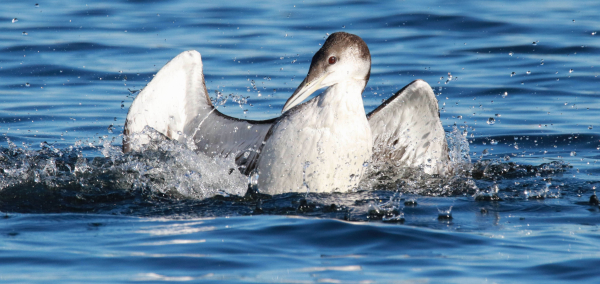
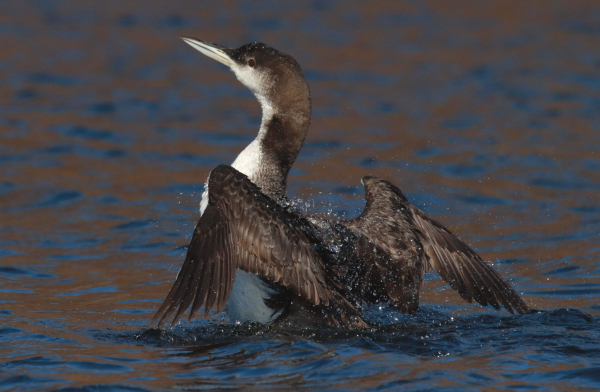
When the young loon began its performance, I credited its initial action to bathing, but it quickly became clear that this was something more, something somewhat theatrical; something of a wild display before an attentive audience of 3 in a boat. Despite being a student of ethology, the study of animal behavior, this was not your basic innate behavioral display, but seemingly a series of unrelated movements that erupted into spreading its wings while spinning, submerging to varying degrees and flapping a wing or both in the process, slapping a wing on the water to create a considerable splash, and rising up from the swimming position to spread its wings and ruffle to make water spray from its feathers as it pointed its bill toward the sky.
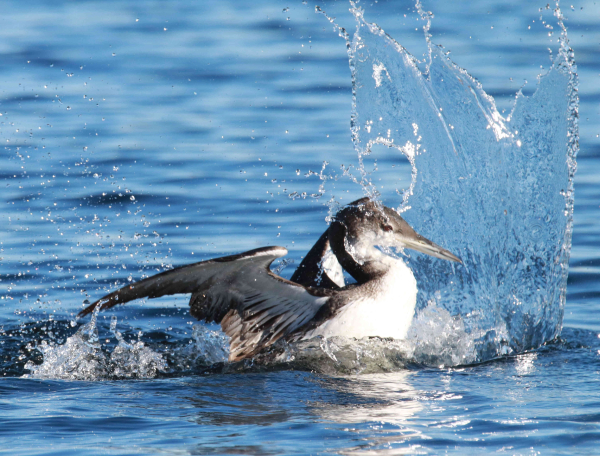
It was also a matter of the duration of the activity and the energy level the loon projected into its movements that seemed to be disconnected in purpose, but connected by rapid actions, all with water spraying in every direction. During what seemed to be a closing phase of the action, the loon settled back onto the water in a swimming position only to race across the surface flailing its wings forward to splash, and continuing raise and splash its wings again in a flapping motion that resembled grounded flight – all while propelling itself across the water in running motions with its broad webbed feet, scooting or sledding rapidly along the water with spray flying in the process.
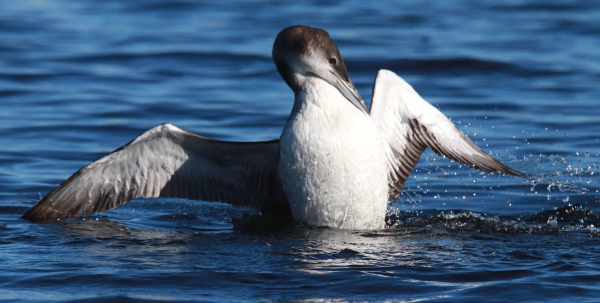
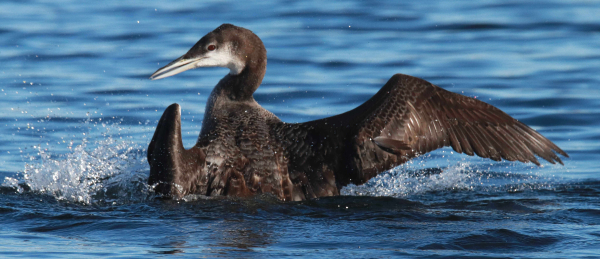
All this as the loon moved from bright blue water to medium blue and into water that reflected the brown color of fall oak leaves reflected among the ripples. The loon calmed a bit for a moment, then erupted once more into another series of “loon dance” moves that appropriately culminated with the hyper-loon rising up for a statuesque wing flapping movement before settling into a swimming position. Then, as it faced us, it voiced its distinctive loon song, twice, as a fitting exclamation point to its performance.
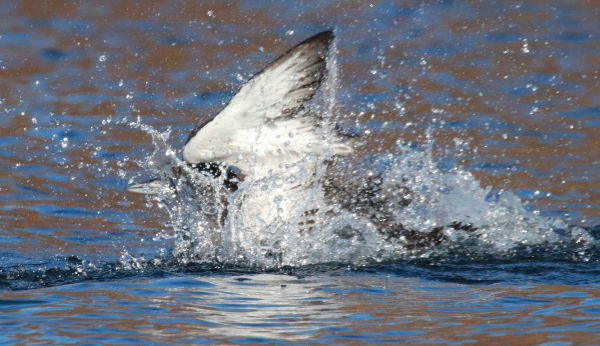
I was busy photographing through the phases of the dance, which made for some rousing moments that seemed to continue and expand in elaborate ways – free form styling at its best. In some of the photos it looks as though the loon is looking directly at us, and as self-centered as it sounds, it seemed as though it was performing for us – mostly in fairly close association to the boat. The boys were not silent during this performance, as we openly felt the need to voice our excitement and impressions during the wild action playing out before us. I have no doubt we will recount this loon photo episode for years to come and I know I will always recount it as “the loon dance” because there is no better way to describe it in a simple way.
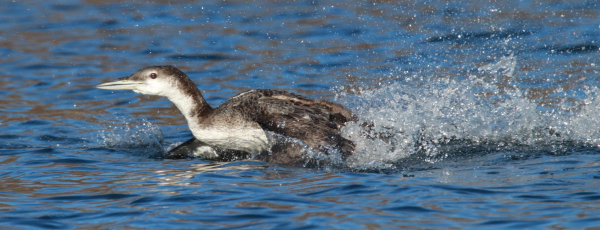
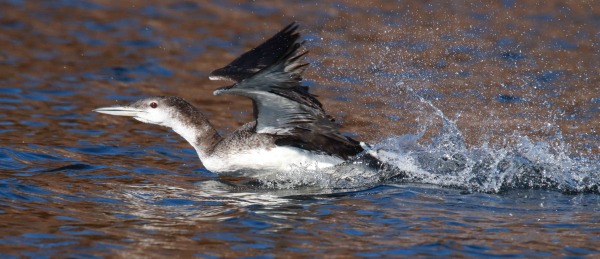
Before the Dance, and After
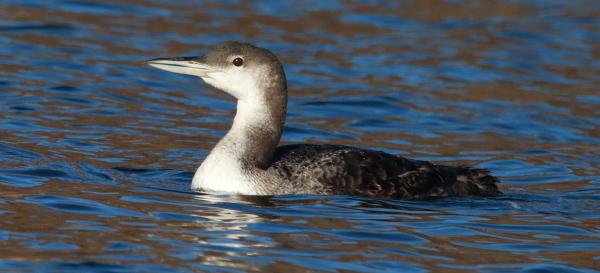
It all began with the sighting of the second loon of the afternoon, after taking beautiful portrait photos of an adult Common Loon in basic plumage, looking so different from the more colorful, classic loon plumage of summer. Craig sighted the second loon that turned out to be a young first-fall loon that appeared to be fishing – diving below the surface a couple times, then preening for a few moments before erupting into the wild dance performance described above without hinting the slightest indication of what we were in for. The third loon was one I observed from the road before I stopped at Andy’s lake home, and coincidentally that loon was positioned in front of the cabin that Craig’s grandparents built in the 1920s. Andy and Craig recalled a number of party stories from their youth at that cabin as I photographed the loon, which was not as cooperative as the first 2 loons. Certainly, each loon is different in the way it reacts to the careful advance of a boat, so we moved on.
Because Andy already pulled his pontoon and dock from the water, Craig was at the helm of his pontoon and doing a great job of maneuvering into positions for photographs. We hoped Craig would join us as a passenger during earlier loon excursions, but today he was really coming through by providing our water-based photo ops. Andy is usually the captain, but I bet he appreciated the chance to relax during Craig’s maiden voyage. Next stop, we headed past Craig’s present-day lake home to check on 11 Trumpeter Swans feeding on the edge of a stand of wild rice with Canada Geese and Mallards.
As we took a look at a gull through binoculars to ascertain it was a Ring-billed Gull, the trumpeting calls of swans broke the quiet, as a pair of the huge white swans took flight among a small group of Canadas that looked tiny by comparison. The waterfowl flew in our direction and I was able to simply take some classic flight photos of one of the Trumpeters and a few pairs as they followed the initial flight. On to the next Common Loon, another adult, then back to the young dancing loon that was mildly relaxed in the still late afternoon, and that was a fitting point to end our loon photo season.
I always have thoughts about what to expect before we climb aboard a loon pontoon, but it always seems as though the loons have their own script to follow as they lead us into their wild realm. And while it is often exciting, we see something new during each voyage, and piece together an idea of the lives of loons on a small Minnesota lake not far from where the northern woodlands meet the Great Plains. The times we spend in the company of loons and other wildlife on the water are always very special and rewarding, and I always seem to manage to take some memorable photos – ’cuz it seems that each loon encounter produces a birding event – especially when shared among friends.
Article and Photographs by Paul Konrad
Share your bird photos and birding experiences at editorstbw2@gmail.com