
Driving north along my local Raptor Route, I was nearing the Ferruginous Hawk nest that now stood abandoned; but looking in that direction a sudden flash of huge black wings startled me for the moment as what turned out to be a recently fledged Bald Eagle took flight! Just outside my window, the big raptor elevated into view on labored wingbeats as it pumped its broad black wings to rise from the ground toward the front of my auto, passing before me as I immediately took my foot off the gas pedal and coasted forward. The big eagle was out of sight until then, hidden behind a veil of tall cattails, but now in full view I imagined the young eagle might not fly far – perhaps just to the hay bales lined up on the opposite side of the road. That brought the big eagle into full sunlight, where its plumage changed from black to brown as it landed.
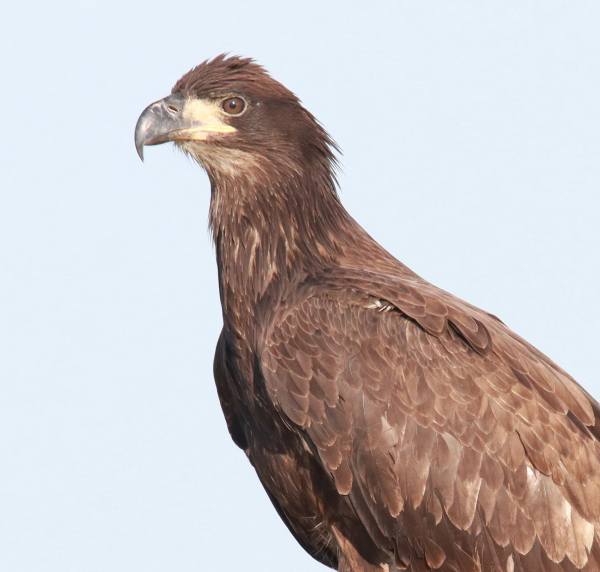
What luck to have the eagle land so close in remarkable late afternoon sunlight! I have only been this close to such a recently fledged Bald Eagle once before, so I knew this was a great opportunity to get a couple impressive photographs, perhaps a nice series of images. The young eagle was aware of my auto, but not concerned, and after getting its bearings with its back to me, it turned to provide a side view, showing that it was obviously a young female considering its especially large size along with the size of its extended feet. After a couple moments, the eagle became a bit mobile, partly opening its wings and walking or hopping along the line of bales in a rather comical way.
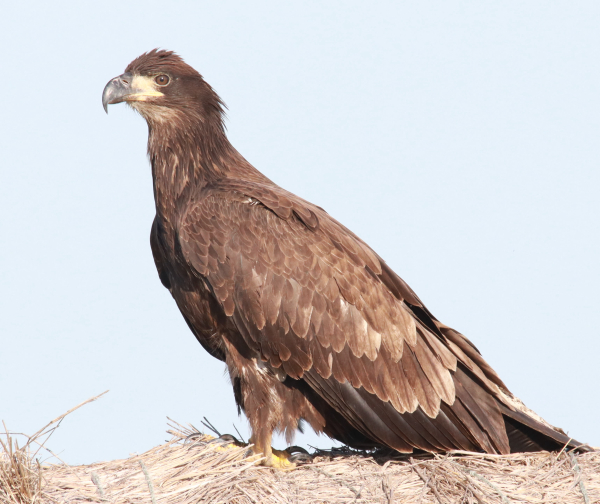
I photographed the action, but with its wings partly shading the face of the eagle, the resulting photos were poor at best. It was fun to see the eagle hustle along nonetheless. Positioned at the end of the hay bales now, the eagle paused for a while, providing some nice opportunities to photograph the bird in perfect sunlight that showed no shadows while highlighting the varied coloration of the raptor’s plumage, feather by feather. We might imagine that a newly fledged Bald Eagle’s plumage should be pretty uniformly colored, but many exposed feathers become a bit faded during the extended period young eagles spend in the open nest and during the post-fledging period in the mid-summer sunlight.
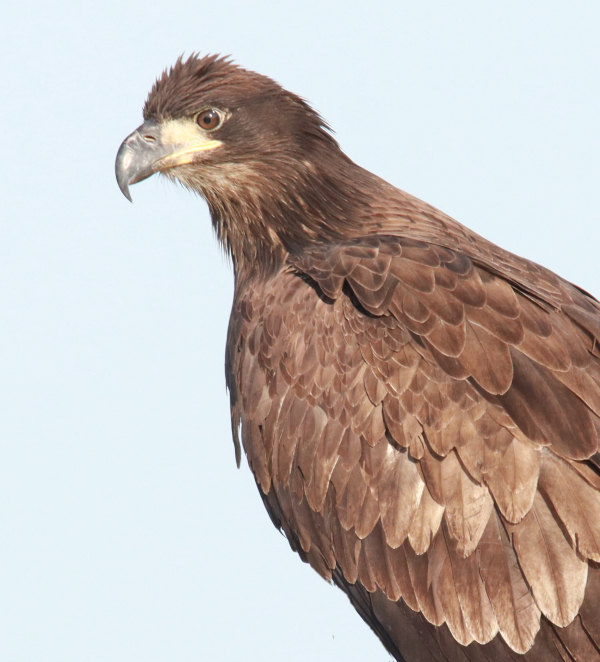
An hour later, excited by the quality of the photos I was able to take of the young Bald Eagle, I began to review the photographs on my computer screen, picking out favorites, reliving the photo period shared with the recently fledged Bald Eagle. While my photo picks provided some nice head-to-toe portraits, I could see some excellent potential for head-and-shoulders portraits too. The sharp eyes and beak, along with the sharp outline of individual feathers really emphasized the chance to create some impressive images by cropping a couple of the original photographs, as indicated by the first, third, and fourth images that illustrate this feature article.
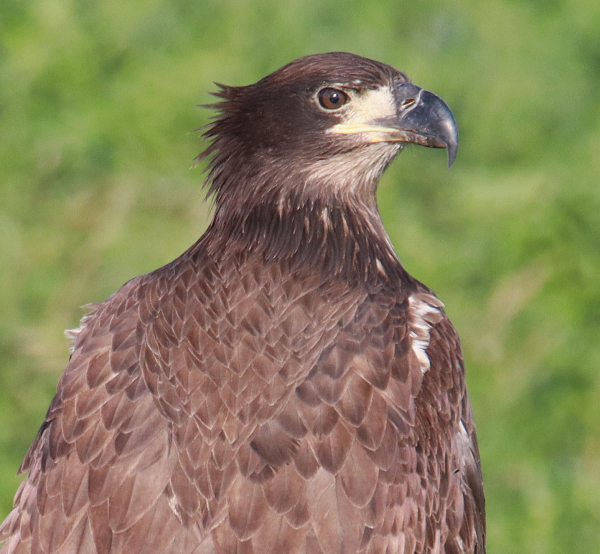
I was aware of only 1 active Bald Eagle nest in Logan County this year, which was located just a mile away from the young eagle’s position when I photographed it. I was unable to see the nest after the big cottonwood where the nest was build produced a thick cover of leaves, but I did see an adult Bald Eagle during one of my visits to the Ferruginous Hawk nest site, so I imagined the eagles were raising at least 1 nestling. Friday’s observation of the recent fledgling within sight of the nesting tree provided an indication of the success of the adult nesting pair, as well as a memorable photo opportunity with a super-raptor close, a bird as big as any North American bird of prey gets. What luck, what fun, what fine photos too.
Article and Photographs by Paul Konrad
Share your bird photos and birding experiences at editorstbw2@gmail.com