
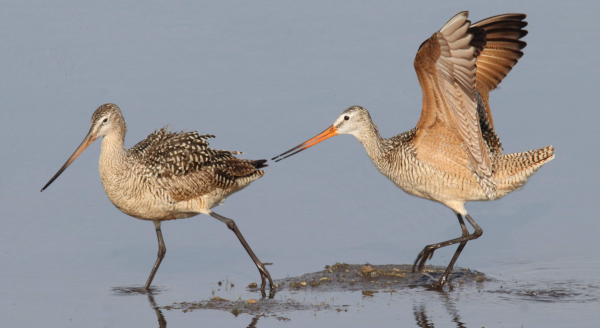
The Amorous Godwits – Charo Marsh has been a remarkable shorebird attraction, as emphasized by the fact that I found a flock of 6 Ruddy Turnstones during their migration stopover – resting, bathing, and preening. This was only the third time I’ve encountered turnstones in the state, and the first time I’ve seen them at Charo. I managed a number of photos of them before they collectively flew low in a tight flock a short distance to an adjacent bay where they began foraging. I followed the turnstones by simply by putting my car in reverse and backing down the vacant road.
A few feet into my reverse mode, a pair of Marbled Godwits flew from right to left close to the front of my windshield as they glided into a shallow water area flooded by a recent rain – adjacent to where I just photographed the turnstones. I didn’t give the godwits a second thought at that point because I was on a turnstone mission, but after taking a few more photos of individual Ruddy Turnstones, I decided to leave. As I progressed a couple hundred feet forward, the godwits caught my attention again, and considering they were wading in shallow mirror-like water, the pair forced me to stop to assess the chance for photos.
Indeed, the godwits provided a special photo op, but little did I know that a moment after focusing on the male, the female would ruffle her body feathers in an attractive way. Attractive to the male, who reacted by spreading his wings high and following the female as she coyly led the male forward, then in a circle. Following her, the male flapped its wings slowly forward, then back again, but mostly held its wings spread above its back. I immediately zoomed my camera lens to fit both the godwits within the photo frame, as the pair of godwits provided a fast-paced photo session that yielded a fine series of photos in the essence of perfect evening sunlight (500mm zoom lens, f-14 aperture, 1/640 shutter speed, 800 ISO).
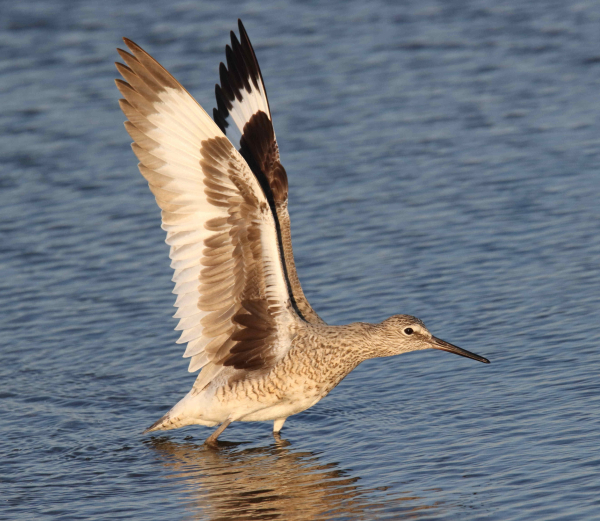
The Mad Willet – After photographing Yellow Warblers and Clay-colored Sparrows among the peak of wild plum blooms at White Lake, I passed south 2 miles to Charo Marsh to see what birds were present at that local hotspot. A fine diversity of shorebirds was present, but only 2 or 3 of each species, except Wilson’s Phalaropes that numbered about a dozen. I stopped and began photographing a pair of American Avocets, some phalaropes, a Least Sandpiper, and a Dunlin after it flew in and landed close by.
I began taking a couple of photos of one member of a pair of Willets that was casually preening while standing in shallow water, when suddenly it spread its wings high above its back and ran toward a Lesser Yellowlegs while calling loudly. Apparently the yellowlegs approached the Willet’s mate too closely, and an especially aggressive response ensued. I was quick to follow the action through my camera lens, taking a series of photos. Unfortunately the initial photo was blurred because I didn’t have my auto focus zeroed in on the Willet when the yellowlegs took flight – with the Willet chasing it with its wings spread high and its mouth and long bill open wide as it called angrily.
As if to emphasize its action to its mate and other birds nearby, the Willet left its wings spread high above its back with its neck and beak stretched forward, providing a few really nice, sharp photos in the best evening sunlight any photographer could hope for. A great example of being ready for action to erupt during a tranquil photo stop. Although the Willet looks quite elegant in the illustration, it is actually very mad. As with the godwit action, I zoomed my lens out a bit from 600 to 500mm to keep the full wingspan of the Willet in the photo frame. The narrow aperture of f-7 also provided a countering fast shutter speed to stop the action (500mm zoom lens, f-7 aperture, 1/2000 shutter speed, 800 ISO).
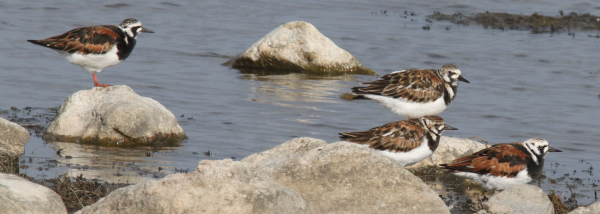
Turnstone Time – In the first segment of this Bird Photography feature, I mentioned my surprise sighting of a flock of 6 Ruddy Turnstones at Charo Marsh – a big surprise, and it was only the third time I’ve sighted this Arctic-nesting species in my home state. Some of the turnstones were in full breeding (alternate) plumage and others were still molting from basic to alternate plumage, which provided an interesting insight into how their migration timing and molt patterns coincided.
Day to day over the course of a week I documented flocks of 6, 16, 2, and 12 Ruddy Turnstones on the northwest shore of Charo, which suggests new birds arrived and others left; or perhaps there were other locations where the Ruddys spent time that I couldn’t see or didn’t find. Now, it appears the representatives of this species have resumed their migration from coastal areas, presumably to tundra nesting sites in the high Arctic islands north of Canada’s mainland. What a thrill to see them foraging here – turning stones over with their beaks as they walked along the shoreline in search of invertebrates beneath them, an action for which these colorful plovers are named for – they were turnstones turning stones.
I had a few opportunities to photograph some of the Ruddy Turnstones during their Charo stopover, but I most liked the first photos I took of 4 of the original 6 I found. By using an f-14 aperture to get as wide an area in focus as possible, I was able to get all 4 turnstones in focus while retaining a fast shutter speed (600mm zoom lens, f-14 aperture, 1/1000 shutter speed, 800 ISO).
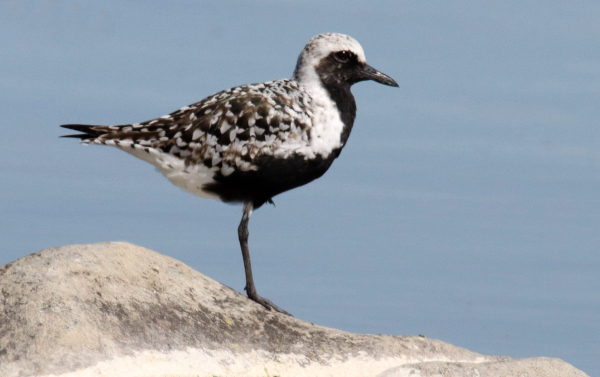
Solo Plover Stopover – During a birding drive through Long Lake National Wildlife Refuge last Wednesday, suddenly there it was: A surprise species I’ve only seen once before in North Dakota, also during spring migration – a Black-bellied Plover! I’ve seen untold numbers of Black-bellies along coastal areas of California, Florida, Texas, and Mexico, but those wintering plovers were in their relatively drab basic plumage. To see them in their full-color alternate plumage on their way to nesting areas far north in the Arctic tundra was quite a treat for this photographer – a rare treat.
Counting myself exceptionally lucky to find this lone migrant resting on a white rock surrounded by tranquil water that reflected a beautiful sky blue, I took a few quick photos before settling in to observe it for a while. It’s one thing to see such an exciting bird, but the fact that the migrating Black-bellied Plover was close enough for me to photograph it was an absolute thrill. The surrounding water reflected the sweetest color of blue that set off the dramatic colors of the plover, and during the 20 minutes I spent in its company, the plover was obviously resting, but it preened a bit too. I hoped for a wing stretch or another interesting movement by the plover, but was satisfied to take some still portraits.
While this was my only my second sighting of a Black-bellied Plover in the state, it topped off a week when I observed 5 personal ‘second state record’ birds that included this plover, a Connecticut Warbler, Bay-breasted Warbler, Yellow-throated Vireo, and Great Crested Flycatcher. I also documented my ‘first of state’ Black-headed Grosbeak just 5 days before seeing the plover – how lucky were those 6 sightings, all within a week’s span? And what exciting migrants will appear next? Good luck with your camera in hand while you are in birding mode as we quickly approach the month of June (600mm zoom lens, f-7 aperture, 1/4000 shutter speed, 800 ISO).
Article and photographs by Paul Konrad
Share your bird photos and birding experiences at editorstbw2@gmail.com