
I had high hopes for my photo trip Wednesday afternoon, driving an hour southeast of my office to an expansive shallow marsh that was filled with waterbirds and ducks, but my primary interest was to photograph wading birds that flew to and from their extensive nesting colony. With big birds flying in every direction – Great Egrets, Great Blue Herons, White-faced Ibis, Snowy Egrets, and more Double-crested Cormorants than all the other birds combined, I was thrilled to see the road that bisected the expansive marsh wasn’t under water.
It had been about 11 months since I visited this nesting colony, just south of the border between the Dakotas and east of the James River. At the same time, I knew this was a good place to photograph grebes with hatchlings, as well as ducks, terns, and other species. The surface of the expansive wetland was like glass, with birds making the only ripples on the surface, and the sunlight would be at peak photo levels during my 2-hour visit to the area. I had it all going in my favor – the birds, the weather, the timing, the lighting, the water, the sky – it was all in place for a fine photo session.
Aah perfecto, but the birds just weren’t cooperative for this eager photographer. They didn’t fly within range of my zoom lens, they didn’t permit a close approach using my mobile blind along the bisecting gravel road, and they didn’t approach my blind when stationary. I hoped time and patience would pay off, but I also know when to bail on a photo blowout. I checked 3 other roads that normally bisect marshes, but each of those roads were under water, limiting my access. Earlier, I noticed an area a few miles north, just across the North Dakota border, and while that location had a lot of American Avocets, Wilson’s Phalaropes, and a few White-face Ibis on the hunt, again the birds were a long distance away and didn’t provide any flyby opportunities.
At that point I was already 15 minutes closer to home, and it was past the period of best lighting, so I considered calling it quits at that point – skunked. But there was still some time, I was still close to ground zero – the nesting colony – so I headed back to retrace the route I took earlier.
A New Grebe Family
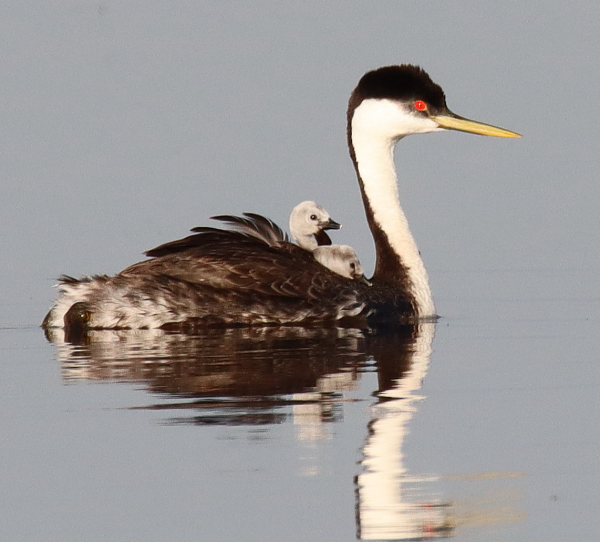
I slowly reversed my mobile blind some more, until I could feel a little tension from the adult grebe; then stopped. I pulled a little to the side to position better with the sun behind me and the grebes before me, and although it was more than a half-hour past prime lighting, I was actually worried about the bright reflection coming off the glassy surface of the water. But I took a couple initial photos to check their look on my camera’s LCD viewer – they looked good at that size, and when I enlarged them in camera.
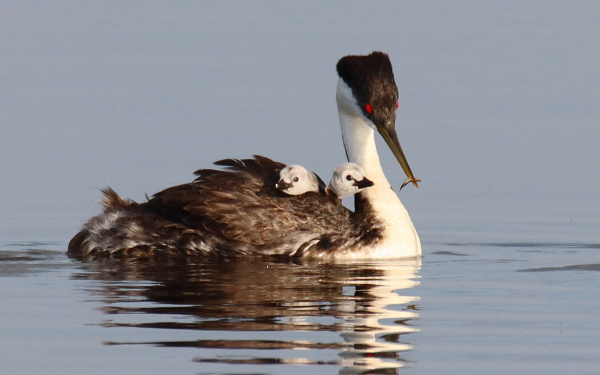
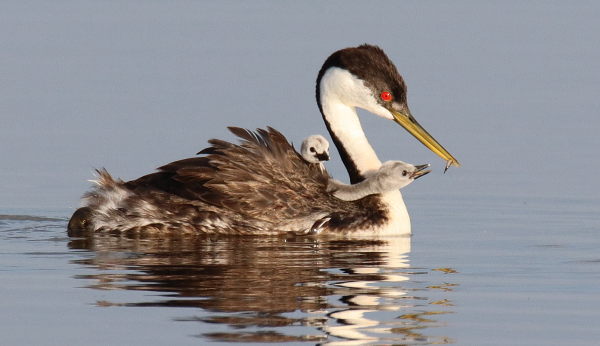
That’s about the time the second adult (presumed male) drew the attention of the female and now the heads of 2 downy hatchlings appeared from beneath the back feathers of the adult. The male was bringing a small fish, which it transferred bill to bill to the female. The fish was small for an adult, if it was meant for the female, but it proved to be at least twice as large as the little guys could handle (swallow). They tried though; the female dangled it in front of them, then she actually dropped it into the water, which precipitated the hungrier of the 2 hatchlings to slip into the water and grab the fish at one end; the downy grebe was eager, but the fish was still too big.
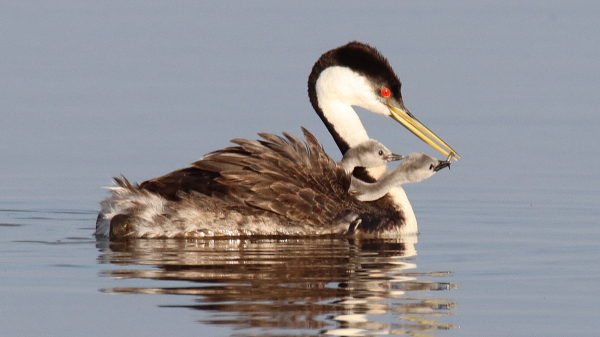
Throughout this period and the continuing grebe activities, I photographed when the adult turned the right way, when the downys popped their heads out of the adult’s back feathers, and when the male brought another fish – this one very small. That’s when the best photo opportunities transpired over a short period of mere seconds. After the male passed the mini-fish to the female, she tempted the young grebes with it by holding it near them. The young grebes reacted by stretching their necks to reach forward, and the more aggressive of the 2 claimed the prize as a quick treat.
This was definitely the best segment of the series of photos I took, mostly because the young grebes were reaching for the fish on “my” side of the adult, rather than on the other side, behind the adult’s neck. Only one photo in that series was out of focus, and I can’t say why it was outta focus, because even from the long distance I was taking these photographs, the other photos were remarkably sharp. Realistically, these photos are an amazing testament to the quality of the Tamron 600-to-150mm zoom lens I was using, which provided these photos attached to my EOS Canon digital camera, which provides 24 megapixels for quality photographs. Even though I was too far away by my usual standards, after I simply cropped the extraneous water from the photos, I was amazed at the quality of the resulting images.
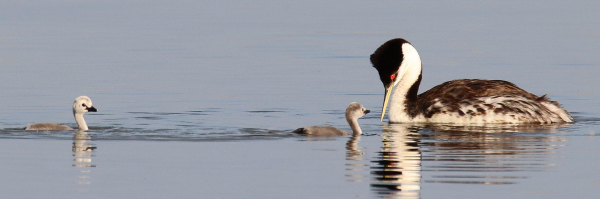
I must point out that the third photo that illustrates this article is one of my favorites for this year, as well as one of my favorite bird photos ever! I’ve really been trying to get this kind of photo of Western Grebes all my photographic life – and last Wednesday, when it looked like my birding photo trip was a bust, I was granted the opportunity and managed to get the photos when the grebes provided the action – WoW!
There probably isn’t a better example to show how sticking with a plan, following a hunch, and hoping for the best eventually pays off, at least in this case, last Wednesday night. I’ll appreciate these photos for a long time, a lifetime, and share them with a lot of people along the way, including you and other readers of The Birding Wire. Who’d have guessed I’d have such luck in the end; but I’d like to think that this is another example of how just getting out there as many hours as possible, when the light is right and the birds are present, to take advantage of photo opportunities along the way. It inspires me, and I hope it inspires you as we enjoy these wonderful days of mid-summer. Good Luck!
Article and photographs by Paul Konrad
Share your bird photos and birding experiences at editorstbw2@gmail.com