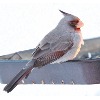
Winter has really set in the past 2 weeks, but especially during the last week with diving winter temperatures, and a recent weather report predicted that in the following 9 days it would snow during 8 of them. Arriving very bluntly, winter had me all but snowbound Sunday afternoon, but I was compelled to man my camera as a flurry of action at my feeding station began. As usual, the Blue Jays attracted the most attention and I began photographing a number of repeat visits to my platform feeder for shelled peanuts and peanut pieces. Fairly early into what turned out to be a bona fide photo session, 3 jays landed within seconds of one another, and that’s when the action ensued.
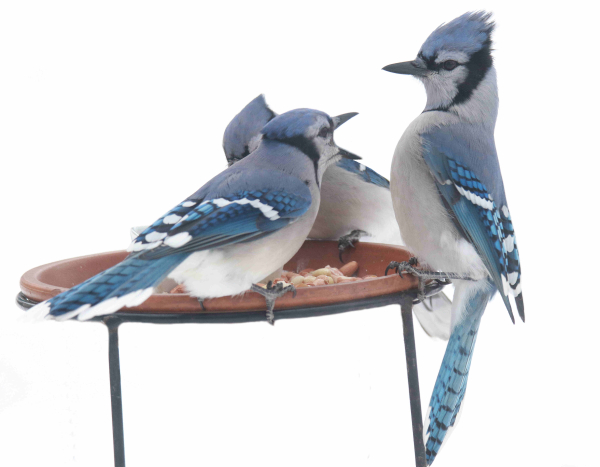
An excellent example of why we always need to be alert for the next opportunity to take action photos, the arrival of second and third Blue Jays at the smallish platform feeder provided the chance to take a quick series action photos (330mm zoom lens, f-6 aperture, 1/640 shutter speed, 800 ISO).
The arrival of the third Blue Jay changed the mood from edgy to antagonistic, as one of the original jays took offense as the new guy tried to gain access to the platform, jabbing with its sharp beak and flailing its wings – the kind of action we always want to be alert for and try to anticipate. The resulting pair of photos turned out to be the basis for me to make this article worthy of developing and publishing, supported with some other representative photos from the photo session. Jays are characters, and you can appreciate their intelligence often when you observe them, and even more so when you photograph them.
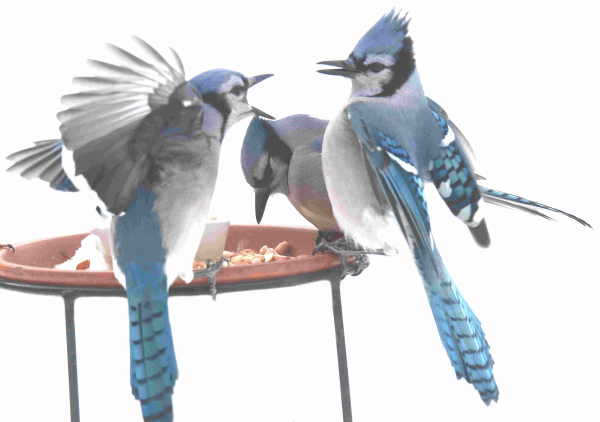
Every action sequence has a beginning, peak, and end – and this was the peak of action, stopped in motion by a relatively fast shutter speed, the fastest possible under the subdued natural light (330mm zoom lens, f-6 aperture, 1/1250 shutter speed, 800 ISO).
As it turned out, the photo opportunities were best during a break between snowfall periods, and even without sunshine, it was obvious that overcast conditions during midday sometimes creates more uniform colors than the broken sunlight and shadows that can result at my feeding station. The uniform white background color provided by the snowy surroundings helped to emphasize the birds from the background, and overall the resulting photographs were quite pleasing – at least the ones that the light meter cooperated on.

A narrow aperture of f-6 was used for all these photos on an overcast day when keeping the fastest shutter speed possible was important, and usually the f-6 was adequate, especially for single-bird portraits (500mm zoom lens, f-6 aperture, 1/1000 shutter speed, 800 ISO).
Too often I’ve found that my camera’s light meter has not been consistent when sunlight is a missing ingredient. The result is that the photos show every possible level of lighting, varying from slightly too light to varying degrees of darker shades toward almost silhouette dark. I’m baffled as to why this is the case, but it underlines the importance of photographing when the sunlight is right, with the sun positioned as directly behind you as possible. But while enjoying the chance to take a lot of photographs of the Blue Jays as they visited the platform feeder and perched adjacent to the feeder, I had a variety of photos to choose from to share with you.
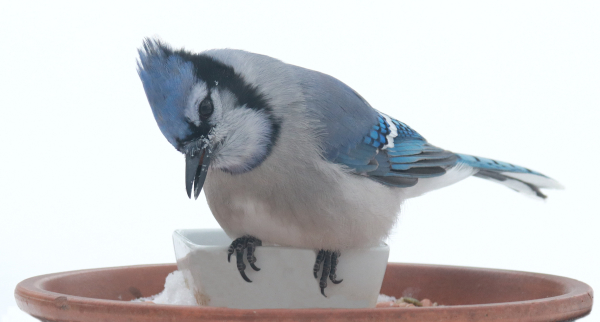
Photographing at a feeder, like this simple platform feeder, provides occasional photo opportunities to take photos of all the species that stop by (300mm zoom lens, f-6 aperture, 1/500 shutter speed, 800 ISO).
Using my zoom lens, it was possible to zoom in and out, depending on the birds before me, taking close-focus portraits at times. The zooming options made it all the more interesting in the midst of the Blue Jay action. If you aren’t using a zoom lens, you can always create the same effect as zooming closer for a portrait simply by cropping a sharp photo. Of course, the real reason for any success photographing the Blue Jays was the point of interest in collecting food at my feeding station. The lesson there is to never underestimate the potential of taking photos of the birds that visit your feeders and birdbath; they can provide an action-packed photo session on occasion, or a even documentary photo of a rare or interesting bird.
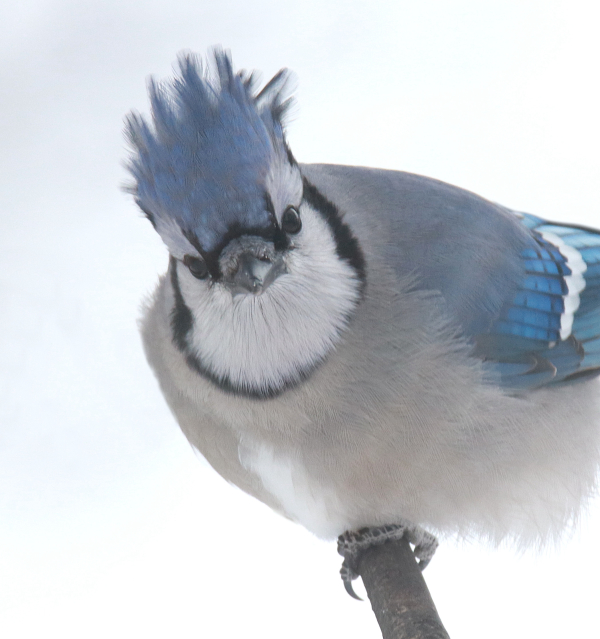
Jays can really show their character, and they often provide examples of how waiting for just the right moment to snap a photo can create a fun portrait that will get some kind of reaction from any viewer (500mm zoom lens, f-6 aperture, 1/800 shutter speed, 800 ISO).
|
It was great fun to take the Blue Jay photos, to have a flurry of activity at and around my feeding station, and sometimes that’s what bird photography is all about – to have fun, take a variety of photographs while studying the birds’ behaviors. In essence, I was taking an exciting break in my work schedule instead of a relaxing one. Realistically, an exciting break gets you fired up to get back to your tasks at hand with a little faster heart rate, a bit of excitement in your step, and a smile on your face to pass on to others. The photos are rewarding, and an exciting part of the experience, but how can you beat a little extra happy-excitement in the midst of a Sunday afternoon? Bird photography can do that. Good luck wherever you are, and whatever weather conditions you are experiencing in your area.
Article and Photographs by Paul Konrad
Share your bird photos and birding experiences at editorstbw2@gmail.com